Wednesday, April 05, 2006

Christian Socialism

Revolutionary ChristChristian socialism has long been a topic of interest to me. I am very active in my church and diocese and was batised as an adult. Nevertheless, my class conciousness and understanding of historical forces that comes with that often come in conflict with the doctrines of organized religion, specifically the Christian church.

I was contacted today by a comrade in Oregon who runs the blog Willamette Reds. A series of posts on Christian socialism caught my eye, an excerpt of which follows:
There exists among the oppressed the task of making God exist. By this I mean that we share a faithfulness to the Gospels and to Tradition as well as a consciousness and means to use the Gospels and tradition in order to provoke and struggle for justice. In that struggle the matter of God is revealed as both ever-present and distant, as intimate as Father and Comrade and as distant Unknowable Other.

The only certain path to Theosis, individually or socially, is through this struggle. Other paths lead there, but none are as certain as the path of the loving struggle for justice. The matter of God is both Beginning and End, both Path and Destination. Constructing that path from a capitalist society forward is the task of making God exist.

More...
Obviously this is not Marxist scientific socialism, but compelling nonetheless. I have to say "Amen brother! Throw the money changers out of the temple!"

I highly recommend visiting the Willamette Reds blog.

France General Strike 2006 Update

Grève Générale 2006!

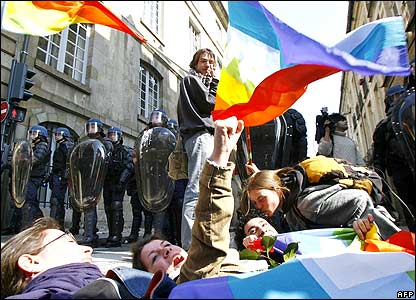
Workers and students across the world have begun to show support for the French movement or take similar action themselves. In France, the strike has continued to gain traction among the unions and public service workers, with over 20% of the public service on strike as of April 4, with over 3 million total people estimated on strike nationwide.
  • In Germany, students occupied the rectorate of Bielefeld university since 1st February in a protest against the introduction of student fees. From 15th February students at Padeborn University were occupying the rectorate of the area's high schools. As of 2nd March these occupations were evicted by force.

  • In the UK, 1.5 million people went on strike against proposed pension cuts. Also, students occupied Sussex University Library to protest against redundancies and cuts in staffing, some declaring solidarity with students in France.

  • In Japan, during the anti-war demonstrations in March 19th, young workers in carried placards against the CPE and new PSE laws which will come into effect in Japan in the near future.

  • In New Zeland, over 1,000 high school students walked out of class to protest against youth pay rates, whilst linking their protest to the events in France. The protest ended with some violence and a sit-down protest in a major intersection.

  • Workers in Gothenburg, Sweden smashed several windows on the Centerpartiet local office in protest against new labour laws proposed by Maud Olofsson, The Chairman of the Swedish liberal party Centerpartiet. She openly admitted that she has been directly inspired by French Prime Minister Dominique de Villepins controversial French CPE law.

    500 people, youths and workers, gathered at the central plaza in Stockholm to demonstrate against the Centerpartiet attack on worker rights and in solidarity with the youth revolt in France. The group was dispersed by mounted police.

    Also, in Denmark 200 protested in front of the French embassy in solidarity with French youths.

  • In the US, millions marched in rallies and strikes across the USA to protest against anti-immigrant bill HR 4437. In the days following the demonstration tens of thousands of students have walked out of high schools and held spontaneous demonstrations, blocking traffic and picketing city halls.

    Several thousand students have been involved in walkouts in Tucson and Phoenix Arizona, in some cases having to break out of their schools to join demonstrations, which have included blocking traffic and in one case throwing rocks at the US border patrol headquarters.

    On Monday 26th a walkout in Los Angeles county involved around 36,000 students. In San Diego, 30-40 student protestors were arrested for truanting on March 29th during one of the protests, and there were reports of 250 students and 80 police officers fighting a pitched battle with blocks of concrete outside Oceanside High School. Demonstrations and further arrests were also reported in Houston, El Paso and Los Angeles.

    In New York, young people from Students for a Democratic Society (SDS) marched to the French Consulate in Manhattan with banners calling for the withdrawal for the CPE.

    SDS was one of the main groups involved in the university occupations and teach-ins in the US during the late '60s, which has been revived in 2006 with 30 chapters across the country. I met some of the leaders of this group recently and I can tell you they are great people. I encourage everyone to consider joining up with the SDS. They have a lot of positive momentum right now.

  • Finally, in Spain on March 31st, a group of around 60 people assembled in front of the French consulate in Barcelona in solidarity with the struggle of the french people against the "CPE, precariousness, exploitation by work, slavery of workers...". A cordon of 20 mossos d'esquadra (Catalan cops) blocked the entrance of the consulate. In November there were two arrests at the consulate during a demonstration held in solidarity with the uprising in the suburbs.
These reports have been summarized from http://www.libcom.org/news/ and other sources.

Sunday, April 02, 2006

Monument to Pro-Life

Edie at Annotated Life wrote:
Edwards' sculpture [...] conveys woman's prison. Spears did not even pose for this “Monument,” which is not a monument to her, or woman, or even the sacrifice of a great deal of a woman's liberty to motherhood. It is a monument to “pro-life,” the sovereignty of a single male cell within a woman's body. It is a monument to vessel-hood. The idealized role of woman under Christian fundamentalism is one of ignorance, pliancy, and subservience; the bearskin rug is fitting décor for such a primitive existence.

More (including pictures of the sculpture)...
Right on, sister, right on. As a socialist, this sort analysis is a dead-on exposure of the fundamentalism which feeds reactionary poltics. "Pro-Life" is nothing but. It is simply a code for the subordination of women under men. Notice how many pro-lifers are also pro-war. If their concern was truely for life, then they would also be anti-war (and anti-death penalty for that matter). This is almost never the case. These folks often also call for fewer social services (which kills the poor), "free-market" economics (which kills the poor) and are against civil rights (which kills the poor and Black).

As socialists we must resist the temptation to accept the terms of debate set forth by the Christian right regarding reporductive freedom. We must retake the moral high ground and expose their hypocricy for what it is. Too many young Western women today have grown up in a world where they enjoy the fruits of the feminist struggle during the 1960s and 1970s. They do not know the danger they face nor why they must remain militant. Thankfully the Conservative right wing is doing everything in their power to remind them. This sculpture should serve as a wake up call that pro-life means subjugating women to the role of sex-slave and child bearer. A better world is possible for women...

I encourage anyone who has not read The Handmaid's Tale to do so. Only when we have a socialist government which represents all people will we be free of the counter-revolutionary tactics of the Conservative right wing.

We Need More Socialism

New found blogging comrade Mike Schafer at thinksocialist.blogspot.com brought to my attention this somewhat surprising opinion piece in the Nation by Ronald Aronson titled "The Left Needs More Socialism."

Aronson starts with:
It's time to break a taboo and place the word "socialism" across the top of the page in a major American progressive magazine. Time for the left to stop repressing the side of ourselves that the right finds most objectionable. Until we thumb our noses at the Democratic pols who have been calling the shots and reassert the very ideas they say are unthinkable, we will keep stumbling around in the dark corners of American politics, wondering how we lost our souls--and how to find them again.

More...
I cannot agree more. The liberal plays into the hands of the right wing by operating on the terrain of fear that is the domain of reactionary politics. Only by embracing a hopeful future, one of economic, social, racial and gender equality where all people are treated with dignity and respect can we hope to offer a coherent vision of the future for our world.

It is time to stop accepting the oppresive commercial/police state governed by mass media fearmongering which makes us too scared to even let our children walk a block alone, afraid to speak up on labor issues in the workplace, afraid to protest against what we know is wrong -- while giving business interests carte blanc to do as they please.

A famous quote from the 1968 Paris Revolt is: "Be Reasonable, Demand the Impossible!"

I say be even more reasonable, demand and fight for the possible, a socialist world governed by peace and cooperation, not war and profit!

Saturday, April 01, 2006

France 2006 General Strike

The world has been watching the French strikes all week. Sure is a lot of red in that crowd, eh? Strike action is spreading from students to public and now even private sector workers. A general strike is looming. Solidarity strikes have sprung up in England and Germany looks to be next. Organizers are continuing the massive strike action in the US versus the racist reactionary anti-immigration agenda of the right wing. Many are murmuring about 1968 and the wave of worker revolt that brought down fascists in several countries, toppled Nixon, and brought socialist governments into power across Europe (and also, unfortunately, led to the Trilateral agenda).

In case you thought you were getting an unbiased view from the American "news" media (including the liberal darling, John Stewart who literally lied about the extent of violence in the strikes), the ICFI correctly reports:
The reaction of the [US] media has been universally hostile, varying from denunciations by the right-wing press of “mob rule” to the more low-key perplexity expressed by the liberal media, which suggests that French are suffering from some type of collective dementia because they believe they have the right to such things as job security.

[...]

In one way or another all of the commentaries suggest the protests are illegitimate. They declare that France’s labor laws and social protections are outmoded and must be “reformed” if corporations are to thrive and create jobs. They suggest that “everyone” agrees with this, everyone, that is, except the millions of workers and young people marching on the streets of France. Echoing the infamous comments of British Prime Minister Tony Blair at the time of the invasion of Iraq, the US media suggests that the strength of a democracy is measured by the ability of political leaders to defy the will of the people and do “what’s right.”

[...]

Complaining that France sported “only” 14 billionaires, as compared to 24 in similarly sized Britain, Pearlstein concludes his column: “Indeed, when you ask French university students who is the Bill Gates of France, they look at you blankly. It’s not simply that they can’t name one. The bigger problem is that they can’t imagine why it matters, or why that has anything to do with why they can’t find a good job.”
The American media is nothing more that the bought whore of Wall Street. Yeah, Gates has created so many jobs for Americans. Perlstein is a moron. Gates has created more jobs in India than in the US, not to mention the hordes of 1099 employees he imports, and he constantly complains about the American education system and how lazy young American's are. He has even made speeches at high schools including the statement that a job as a street sweeper was considered "opportunity" by our forefathers. He of course forgets to mention that systemic racism and anti-labor practices meant that is was much easier for capitalists to exploit the masses 100 years ago (which I'm sure is truely what he is complaining about).

The IWW had posted a statement from the CNT-F some excerpts of which follow:
Three million demonstrators on Tuesday 28th March! And it was a weekday... so that's three million on strike! Both public-sector and private-sector employees realised how important it was to strike, in order to achieve the greatest number possible on the streets to express their total rejection of the CPE, and indeed of precarious labour in general.

[...]

The CNT calls on all workers, on the unemployed, on precarious workers and "sans-papiers" to join with the university and high-school students and participate in the general assemblies, so that sector by sector we can build the strike from the grassroots.
The CWI reports:
There are more and more discussions amongst workers about the need for a general strike to try to turn the tide against the series of attacks they have suffered. While currently public sector workers feel more confident to strike on the days of protest there is also anger amongst the private sector as well. If private sector workers saw that there was the chance of a generalised struggle that would not leave them isolated in their individual companies then they too would join in. While a national student meeting has called for blockades of railway stations and motorways on March 30 and a general strike on April 4, a more generalised strategy is needed. However it cannot be ruled out that the French tradition of spontaneous strikes will be seen again with workers deciding to continue striking.
We at FoOL stand in solidarity with all of the strikers fighting for a better world. We stand against the neo-liberal agenda which reduces all life to a question of profits. We encourage our brothers and sisters to consider marching and striking in solidarity wherever you may live or work, to stand up and fight to end the attacks by capital on the working class.

For a first hand account from a perspetive sympathetic to the strikers, and eyewitness photos as well, I highly encourage you to visit http://libcom.org/blog - unrest in france


Mar 31, 2006: 2 hour long blockade of the Gare de Lyon train station in central Paris
more photos at http://libcom.org/blog

Cross posted at the Uncapitalist Journal.

IWW Organizes 10 Starbucks

A bit late, but I wanted to post on the IWW victory versus Starbucks. On March 8, 2006, the IWW reports that:
The IWW Starbucks Workers Union won a watershed victory yesterday in the first National Labor Relations Board conflict over unfair labor practices between the world's largest coffee chain and the baristas who work there. Faced with the prospect of having its widespread union-busting campaign exposed in a public hearing, Starbucks agreed to remedy all of the myriad violations committed against workers who have organized a union.

[...]

The NLRB complaint against Starbucks which resulted in this settlement outlined a widespread anti-union effort that extended to upper level management, including a Starbucks Senior Vice President. Fifteen Starbucks employees were named in the complaint.
Thanks to Puritan City for their post on this story. I'm kicking myself for not buying some IWW Starbucks Union T-shirts when I was in The City.

Links:

Wednesday, March 29, 2006

Massive Protests Against Immigration Law

Across the US this week there have been massive protests against a new immigration law in Congress. The protests have lasted for over 4 days and are still going strong, led by the youth. The NY Daily News reported on March 28th:
Massive protests by Latino immigrants have rocked more than a dozen major U.S. cities during the past few weeks in opposition to tough new immigration bills before Congress.

Not since the civil rights movement of the 1960s have street demonstrations spread so rapidly to so many cities - and never have Latinos turned out in such astonishing numbers.

"The sleeping Latino giant has finally awakened," said Assemblyman Felix Ortiz (D-Brooklyn), who participated in several of the protests last week.

And New York City, which has been fairly quiet so far, could be next with Latino religious and immigrant leaders planning a protest march over the Brooklyn Bridge on Saturday.

The largest rally until now has been in Los Angeles, where the new mayor, Antonio Villaraigosa, spoke Saturday to a crowd estimated by police at more than a half-million [people].

What else?
"These are your neighbors and co-workers," said Ellen Stutzman, a 23-year-old researcher for the Writers Guild. "I hate it when people say they are illegal. They're just undocumented. We've made them to be the enemy, and they're not."

and...

LOS ANGELES, March 27, 2006 - LA school district is reporting 24,680 students have walked out of classes today to protest anti-immigrant law H.R. 4437. An official from LAUSD said that students from 52 separate middle schools and high schools throughout the district have walked out. Many students have joined a rally now taking place at city hall numbering in the 1000’s. There are also reports of walkouts in other school districts. The district is expecting more walkouts tomorrow.

and...

[Minuteman] Gilchrist and a handful of supporters arrived on two previous Fridays in front of El Chinaco restaurant to protest its owner, city council candidate Mirna Burciaga, for opposing local police as Immigration and Customs Enforcement (ICE) agents and to retaliate for weekly protests occurring in front of City Council member Gary Monahan's beer bar, a popular Minuteman outpost.

Gilchrist fired off an email accusing Burciaga of being a “racial supremacist” and a member of “racist groups.” No proof of that was offered, but in a flyer Gilchrist cast his own racist net over all undocumented immigrants:

“Does MIRNA BURCIAGA envision Costa Mesa as a criminal haven sanctuary city, infested with drug dealers, murderers, child molesters, robbers, and rapists wandering freely without any interference from law enforcement?”

(The Minutemen were forced off the streets due to consistent anti-racist protests)
And of course:
It's better to die on your feet, than to live on your knees...
-Emiliano Zapata
La Lucha Continua!

Saturday, March 25, 2006

Rachel Corrie with Palestinian Children


I found this picture of Rachel Corrie which seems to be making the circuit of the right wing sites to show why they think she is a terrorist. Here we see her angrily burning a piece of paper which appears to be a hand-drawn flag. I don't understand why the righ wingers get so angry about this sort of thing (they say she is burning an American flag) while ignoring the fact that many of the children surrounding Rachel were likely killed by occupation forces since this picture was taken. What is more important - a bit of paper, or human lives lived with dignity and free of fear?

I make an appeal to all people to bring an end to war and injustice through solidarity and understanding. We must come together in the spirit of true internationalism and replace imperialism (including Zionist imperialism) with socialist principles of direct democracy, cooperation, understanding, anti-racism and anti-sexism.

Tags:
, , , , , , , , , ,

Friday, March 24, 2006

Why Jews Must Speak Up on Palestine

Jonathan Tasini had a good post related to the Rachel Corrie issue, over at The Huffington Post. Titled "Why Jews Must Speak Up on Palestine" which starts as follows:
Yesterday, I spoke at an event in New York City called Rachel's Words. Two years ago, Rachel Corrie, a human rights activist, was crushed to death by an Israeli Army bulldozer as she tried to protect the home of a Palestinian pharmacist from demolition in Rafah, Gaza Strip. She was 23. A play based on her writing, "My Name is Rachel Corrie" was scheduled to open yesterday in New York City but it's debut was postponed indefinitely, in all likelihood because of the controversy it would cause in a city with such a large Jewish audience.

As a Jew who lived in Israel for seven years and whose family still lives there and has deep roots going back more than 80 years, it breaks my heart that there is a refusal to grapple with an almost untouchable topic in our country: why does the United States have such a one-sided policy in the Israel-Palestine conflict? And it's the reason I agreed to speak at the event which honored Rachel's life and her beliefs.

More...
It is unfortunate that so many right wingers and others equate Zionism with general Jewish or American interests. Any critique of Zionist policy is often greeted with the usual litany of being anti-Semetic or pro-terrorist, both of which are completely incorrect. I am happy to see that Tasini has stepped forward to call for greater Jewish and Palestinian solidarity and happy that Rachel Corrie's sacrifice is acting as a catalyst.

Saturday, March 18, 2006

American Vertigo

As many folks will already know, Bernard Heri Levy's (BHL) American Vertigo (available at Powell's Books) is taking the liberal intelligentsia by storm these days. Levy is a pop-philosopher, describing his book as "following in the footsteps of de Tocqueville," talked about his book to New York Magazine as follows:
“The trip was under three shadows,” BHL explains. “The shadow of the war in Iraq, the shadow of an election, and the shadow of Katrina,” although the hurricane hadn’t struck at the time he wrote the book. “The anti-ci-pated shadow of Katrina, as you see. I was in New Orleans four or five months before Katrina, and I more or less foresee what is going to happen."
OK, so far so lame. In fact, the vast majority of content produced by American media regarding BHL is dismissive and spiteful.

Enter Michael Feldman's "What Do You Know?," a radio show distributed by PRI. On March 4, 2006, Feldman interviews BHL regarding the new book. Feldman is a comedian and tried to engage BHL in the usual blather you would expect but BHL did not take the bait. In fact, BHL was mannered, polite and uncompromising, which is exceedingly rare, if not unique, in American media of any type. BHL in my opinion gave an exceptional socialist analysis of the state of American culture and defended his position quite well in the face of a less than enthusiastic audience.

The audio is available from PRI: The Show - March 4, 2006 (RealAudio, advance to minute 6:00 where the BHL interview begins where Feldman tries to put BHL on his heals, minute 13:00 is where the truely interesting content begins as BHL smacks Feldman down) and I encourage you to give it a listen.

My Name Is Rachel Corrie

Rachel CorrieSurprisingly few people on the left have heard of Rachel Corrie. Rachel was a peace activist uncompromisingly committed to her ideals who died for her convictions. It is now the third anniversary of her murder in Gaza, Palestine.

Rachel was a member of the International Solidarity Movement (ISM). She joined this direct action network of young activists in order to lend support to the Palestinian cause. As a member if the ISM, she participated onsite in a monitoring and obstruction exercise targeting the illegal clearing of land by Israeli forces. On March 16, 2003 Rachel tried to stop a Caterpillar bulldozer operated by Israeli security forces from smashing the house of a politically active Palestinian doctor (in Rafah, Gaza). Eyewitness Tom Dale describes the event as follows:
The bulldozer drove toward Rachel slowly, gathering earth in its scoop as it went. She knelt there, she did not move. The bulldozer reached her and she began to stand up, climbing onto the mound of earth. She appeared to be looking into the cockpit. The bulldozer continued to push Rachel, so she slipped down the mound of earth, turning as she went. Her faced showed she was panicking and it was clear she was in danger of being overwhelmed.

All the activists were screaming at the bulldozer to stop and gesturing to the crew about Rachel's presence. We were in clear view as Rachel had been, they continued. They pushed Rachel, first beneath the scoop, then beneath the blade, then continued till her body was beneath the cockpit. They waited over her for a few seconds, before reversing. They reversed with the blade pressed down, so it scraped over her body a second time. Every second I believed they would stop but they never did.

I ran for an ambulance, she was gasping and her face was covered in blood from a gash cutting her face from lip to cheek. She was showing signs of brain hemorrhaging. She died in the ambulance a few minutes later of massive internal injuries. She was a brilliant, bright and amazing person, immensely brave and committed. She is gone and I cannot believe it.
The Nation's Philip Weiss reported this week in his article To Hot for New York on a book which is currently available called "My Name is Rachel Corrie." The book is a play, which has yet to premiere in New York for unclear reasons, but American Jewish unease over the recent Hamas victory was cited. Weiss describes the book as "[a] self-portrait of a sensitive woman struggling to find her purpose, and a polemic on the horrors of Israeli occupation."

Apparently not available from the corporate (apolitical?) juggernaut Amazon, anyone interested in getting a copy of the play can purchase it from the union friendly Powell’s Books or you can get a copy of Rachel's Letters on which the play is based from AK Press. (Correction: Powell's, Amazon, and other American booksellers have the screenplay "My Name is Rachel Corrie" available for pre-order, it should be released in April, 2006).

I would recommend that anyone participating in anti-war movements or protests consider linking the tragedy of Rachel's murder with the generalized message against all war and specifically the Global War on Terror (GWOT). Rachel died fighting against state terror (systematic destruction of homes and lives). The youth of America who entered the Armed Forces to escape poverty and find purpose, and the youth of Iraq fighting for the freedom of their country against imperialism are killing, dying and being maimed in the same way. As Karl Marx brilliantly wrote "we must make the frozen conditions dance by singing to their own melody," namely that the GWOT is not a Global War on Terror, but a Global War of Terror.

The late, great Phil Ochs sings in "I Ain't Marching Anymore" that "It's always the old who lead us into war, and always the young who die." I believe that Rachel's story is the epitome of this sentiment.

Rachel reminds us that the fight against the evil of capitalist imperialism is not one that we can take lightly nor do at our own convenience. Through solidarity, which is the reflective love and respect of our fellow men and women regardless of differences, we can achieve peace and prosperity for all.

And yes, like Rachel, we have to be willing to be martyrs in this struggle.

Links & References:

That Is A Big Number

Opponents of a new French labour law are calling for at least a million people to demonstrate against the controversial legislation on Saturday. (Continue here.)
These protestors just won't go away. Since early February, protests against the de Villepin government's new First Job Contract (CPE) have given the French establishment a headache it was surely hoping to avoid, after the referendum defeat and youth riots in 2005. French students, supported by the trade unions, the Socialist Party and the Communists, have shut down their schools and universities, and organised marches drawing tens and even hundreds of thousands of people onto the streets - and there seems to be no end in sight, despite attempts to negotiate a cessation with union bosses.

The government has argued thet youth unemployment rates, the highest in France, justify these special measures. So why are a majority of people against the new reform to employment law? It is not only sympathy to the plight of young people. The issue is intrinsically linked to the wider sense of distrust people in France have for the authorities. Many are worried the CPE could lead to more general attacks on working people. And this fear is not without justification. Laurence Parisot, head of the Medef business lobby, recently told reporters, "It's never good to treat young workers in a separate category."

Thursday, March 16, 2006

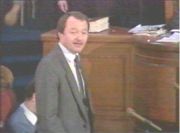
The Case of Ken Livingstone

Last February the Mayor of London, Ken Livingstone, was suspended from office by the Adjudication Panel for England. An independent tribunal, the Panel had been investigating complaints over Livingstone's comments to a journalist from the Evening Standard. His offence? Comparing the journalist - who happened to be Jewish - to a concentration camp guard, in reference to the Standard's historical support for Fascism and long campaign against him personally. It was argued that Livingstone had brought the Mayoral office into disrepute through his comments - a charge he denied. Since then, a judge has frozen the suspension, to give Livingstone time to appeal.

My first reaction to the issue was, I imagine, like many other people in Britain. Outrage. It doesn't matter who Livingstone is; all that matters is what we is - London's chosen Mayor. It wouldn't matter if he was a fully paid-up member of the British National Party, my outrage would have been the same. Here was a Mayor, supported by 55.4% of voters, being suspended by an unaccountable tribunal... who no one elected. Frankly, it doesn't matter to me whether Ken Livingstone's remarks offended anyone; I don't care if they were insensitive or brought his office into disrepute. Maybe they did. The point is, Livingstone had a mandate from the electorate, one that cannot be revoked without their consent.

It is interesting to consider that Oliver Finegold of the Evening Standard and the Adjudication Panel may have saved Ken Livingstone's political career. Before the Panel's ruling, the mass media had launched concerted attacks on the Mayor and branded him an anti-Semite. The irony being, of course, that Livingstone has campaigned against racism throughout his entire political life - and is the current chairman of United Against Fascism. Of course, in the eyes of the right-wing press this was quite irrelevant; as a leftish politician, attacking Ken Livingstone is simply the most important consideration.

Jon Benjamin, of the Board of Deputies, is reported to have said, "With freedom of expression comes responsibility to be sensitive to other people's feelings." He added, "There were a large number of people who were offended and they should be equally free to report their concerns." I cannot be the only one to be contemptuous of this laughable argument. No one is denying people's right to be offended, or to "report" their concerns. But if the Mayor's critics had any genuine commitment to freedom of expression, they would accept the only people who have a legitimate right to remove Livingstone from office are his constituents: no matter how offended one may be.

As Ken Livingstone said himself, his suspension was a fundamental attack on our democratic rights. That message needs to be shouted from the rooftops. This cannot be allowed to happen. A short while ago, Tony Blair effectively said his decision to launch the Iraq war had divine support. This offended me. All wars are tragic; appealing to a spiritual authority to justify them is intellectually brankrupt, cowardly, morally repugnant and generally idiotic. I felt Blair's remarks brought the office of the prime minister into disrepute. Yet Blair, despite having less of a popular mandate than the Mayor of London, will not be brought to account for those comments; indeed they have already fallen off the headlines.

And yet, despite my democratic ideals, there is very little I - or anyone else - can do. The only route by which Ken Livingstone can appeal, is to challenge the assertion that the remarks brought his office into disrepute. The wider implications of deposing a democratically elected politician for mere speech have not been addressed. This is the result of the United Kingdom's archaic constitutional framework. Under the various Parliamentary conventions and so-called constitutional Acts (a term invented entirely by the courts to integrate English law into the European Union) which govern this country, local government has no inalienable legal right to exist, despite often being more democratic than Westminster. Sovereignty belongs not to the people, but to the Crown in Parliament.

That is the legal basis for the Mayoral Office - as an institution of local government. Like Blair's unfortunate (if entirely accurate) comments towards the devolved Scottish Parliament, the Mayor of London has no more power than a parish council! In the eyes of the UK constitution, Ken Livingstone gets his authority from Parliament, rather then the people of London. As a delegated institution, the Mayor - and indeed all local government - can be manipulated and even abolished on the whim of 646 Members of Parliament, despite the wishes of the 828,380 Londoners who supported Livingstone's bid to server as their Mayor.
There is, of course, a worrying precedent here. Under the post-1979 Conservative Governments, as part of her campaign against working people, Margaret Thatcher abolished the Greater London Council (forerunner of the London Assembly) and the metropolitan county councils. Then too, as Leader of the GLC and thorn in the side of the Tories, Ken Livingstone stood on the side of democracy and the people. Without wishing to idealise the man, he is at least consistent in opposing the arbitrary disenfranchisement of the public. Despite all of the setbacks, I remain convinced that, eventually, democracy will prevail.

The GLC was abolished, and yet here we are, with devolution for London. Livingstone was expelled from New Labour and unjustly deprived of the Party's endorsement for his candidacy, yet he has been grudgingly allowed to return and has now been elected as Mayor of London twice, in the first instance as an independent. At the end of the day, even the most apolitical people don't like being ordered around by self-important little despots.

Wednesday, March 15, 2006

Surprise, Surprise!

Bush Administration's Labour Rights Record Appalling, according to new report by the ICFTU:
Serious violations of labour rights in the United States are on the increase, according to a new report issued by the ICFTU today. The report, which coincides with a World Trade Organisation review of US trade policies, details a catalogue of breaches of international standards concerning freedom of association, the right to collective bargaining and child labour, and shows a clear trend towards lower standards under the Bush Administration.


"The credibility of the US, which takes a strong international stand on human rights issues, is severely damaged by the lack of protection for working people, especially the most vulnerable, within its own borders", said Guy Ryder, ICFTU General Secretary, adding that "this only encourages other governments to seek competitive advantage in global markets by violating fundamental workers' rights".

[Continue here.]
You can also read the full reports here.

Saturday, March 11, 2006

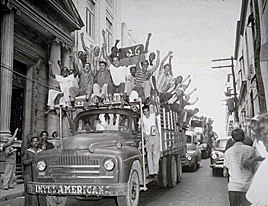
Review: Che and Cuba

Last summer, I bought a copy of Mike Gonzalez's excellent book, Che Guevara and the Cuban Revolution (American comrades should see here), at a Bookmarks stall during the Tolpuddle Martyrs rally. At the time, being busy with other things (such as getting sunburnt), I only glanced at it. Over the last few days, however, I've finally had time to properly read through it. And I can tell you, walking through that crowd of recruiters all trying to sell their own party rags, just to get to the Bookmarks tent, was absolutely worth it! I thoroughly enjoyed this unique perspective on Che and Cuba.

As the book says, "Mike Gonzalez is a senior lecturer in Hispanic Studies at Glasgow University. He has written widely on Latin American literature and culture, and on the politics of contemporary Latin America." So far, so good - the guy knows his stuff. However, Gonzalez also happens to be a member of the Socialist Workers Platform of the Scottish Socialist Party, and is in fact on the editorial board of the International Socialism journal. So some people may be rather put off - the Socialist Workers Party not being the most popular crowd in certain circles!

Nevertheless, for such a political individual, Gonzalez does a remarkable job of presenting a balanced account of Guevara's life (including his early years), with special examination of his role in the Cuban Revolution - its background, actual victory, and subsequent effect on the Cuban state and people. Of course, Gonzalez does not pretend to be disinterested or unbiased - he is obviously a committed socialist and believes strongly in its ideals. His arguments are therefore all the more passionate.

Gonzalez does, however, also detail Guevara's flaws and how they served to distort the Cuban experiment. For example, Gonzalez is critical of Guevara's quasi-Nietzschean belief in the power of the will to overcome material obstacles. In that regard, the account remains solidly left-wing, as the criticism is directed at the obstacles to revolutionary socialism in Cuba, rather than its attempted construction per se. The book is perhaps, therefore, suited more to those who are already favourably minded of socialism.

A second positive feature of the book - to me, at least - is Gonzalez's attempt to explain the role of Che's ideals in the growing anti-capitalist movement today. As a figure that is often denigrated by commercial exploitation and mocked by the liberal left as an icon of disillusioned middle-class teenagers, it is enjoyable to see the Argentinean Marxist restored to a position worthy of his lofty goals and inspiring story of self-sacrifice and anti-imperialist struggle. In short, I would strongly recommend this book!

To those of a socialist persuasion, the following IS online article from 1980 may also be worth reading: Cuba, Castro and Socialism - by Peter Binns and Mike Gonzalez!

Friday, March 10, 2006

Lockout 484

How many times have you listened to the following statement: trade unions are now obsolete. They were necessary to protect workers' pay and conditions, the conventional argument runs, but are now led by greedy and corrupt union barons who make unreasonable demands at the expense of the taxpayer and economic efficiency.

However, on occasion, a particularly acrimonious industrial dispute comes to the fore, highlighting the continuing, vital role of unions in the workforce and wider community. The Gate Gourmet controversy in Britain was a good example of this. The story of Lockout 484 in Meredosia, Illinois is another.


I first read about this story in the Monthly Review zine. Take a look yourself. The brutal attempt by the Celanese Corporation to attack the living standards of their chemical plant workers through breaking their union, the International Brotherhood of Boilermakers, in a lockout, shows that more employment protection, rather than less, is necessary. The use of strike-breaking private security firms like Special Response, and the pro-business agenda of the judiciary, both exposed in Lockout 484, should convince everybody that employers cannot simply be trusted to secure for workers a fair deal.

Without solidarity between working people, and independent and strong trade unions, no one is safe from the profit-grabbing machinations of global capitalism.

Thursday, March 09, 2006

Dear Comrade Lula

Very nice to see you enjoying yourself in Britain. Shame the weather was a bit crap, but then if you wanted a good holiday, you should have travelled somewhere warmer! Hopefully that prat Mr Blair didn't scare you away - the Prime Minister gets a bit excited when the cameras turn towards him. Still, you seemed to get on rather well. I must say it was nice to hear that Brazil believes in "the crucial importance of democracy".

Did you know that Mr Blair's government, which holds an absolute majority of seats, enjoys the backing of only one in five eligible voters? Eighty percent of the electorate didn't vote for a Labour Party candidate or sitting MP in the 2005 general election. Wow, makes you think, huh? Oh well. The will of the people can't be questioned, I suppose. Preserving freedom and democracy is probably too important a matter to be left to the people.

It was also heart-warming to hear of the mutual commitment our two countries share in fighting "poverty, injustice and exclusion" and of recognising the importance of "peace, security, human rights and social justice". Personally I didn't know the United Kingdom was committed to any of those, considering all the wars we've been fighting and all the people we've banged up in jail without even the possibility of a fair trial. Not to mention rising inequality and unemployment.

Don't get me wrong - all the talk of "shaping sustainable development, eradicating poverty, promoting social inclusion and improving quality of life" very welcome. As an internationalist, I'd like to see a lot more of you in the future. Just be sure to watch your cutlery whenever Mr Blair comes round for dinner.

Yours sincerely,
Dan

Older Workers, Unite!

The following comments were made by Brendan Barber, General Secretary of the British Trades Union Congress, in response to the government's publication of new anti-age discrimination laws:
"At the moment it's all too easy for employers to treat staff or job applicants unfairly either because they're young and seen as too inexperienced, or regarded as too old and over the hill. These new regulations will make the world of difference because they will force employers to treat workers of all ages fairly.

But the Government could have gone further, and we are disappointed that the regulations will see younger workers still being paid a lower minimum wage than their older workmates.

And on redundancy, it's a shame that the Government hasn't seen fit to bring all workers up to the higher rates of compensation that will continue to be paid out to older workers losing their jobs. All workers, regardless of their age, should get the same payment when they are unfortunate enough to be made redundant."

Ageism remains one of the few acceptable forms of discrimination in Britain, and no doubt in many other countries as well.

So this initiative by the Department of Work and Pensions, coming after a long consultation process, needs to be welcomed as a positive development. We must also remember that while many older women find it especially hard to gain viable employment, it remains to be seen whether women's issues are tackled in the final proposal.

Considering the recent publicity over the gender pay gap, it seems possibly that any omissions in the current plan will be rectified, but we cannot rely on that hope alone.

In other words: it's good start, but just a start.

Tuesday, March 07, 2006

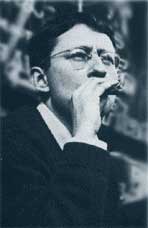
Guy Debord a.k.a. Situationist Pt. I


Readers of this blog will no doubt have noticed that it is proclaimed to be "situationist" and further doubtlessly (for the non-anarchists out there) have scratched their heads wondering what the heck that exactly means.

Wikipedia offers:
The journal Internationale Situationniste defined situationist as "having to do with the theory or practical activity of constructing situations." The same journal defined situationism as "a meaningless term improperly derived from the above. There is no such thing as situationism, which would mean a doctrine of interpretation of existing facts. The notion of situationism is obviously devised by anti-situationist." (see http://en.wikipedia.org/wiki/Situationist)
Which is a quite decent summary, and verifiable from many sources. But what does "constructing situations" mean? Well, I'm going to leave a deep-dive into general situationist thought for another post and instead redirect the spotlight onto Guy Debord, the key figure in the Situationist International and author of the brilliant "Society of the Spectacle."

A brief bio of Guy Debord from Nothingness.org (the de facto home of the Situationist International) reads as follows:
Self-proclaimed leader of the Situationist International, Guy Debord was certainly responsible for the longevity and high profile of Situationist ideas, although the equation of the SI with Guy Debord would be misleading. Brilliant but autocratic, Debord helped both unify situationist praxis and destroy its expansion into areas not explicitly in line with his own ideas. His text The Society of the Spectacle remains today one of the great theoretical works on modern-day capital, cultural imperialism, and the role of mediation in social relationships.

After the dissolution of the Situationist International, Debord was tangentially implicated in the assassination of his friend and publisher Gérard Lebovici. The accusations infuriated Debord, and he consequently prohibited the showing of his films in France during his lifetime. Debord continued writing, and in 1989 he published his Commentaries on the Society of the Spectacle, arguing that everything he wrote in 1967 was still true, with one major exception: the society of the spectacle had reached a new form, that of the integrated spectacle. The prospect of overturning the society of the spectacle seemed more unlikely than ever. In December of 1994, at the age of 62, Debord killed himself. The French press, who had always repudiated the significance of the Situationist International, suddenly made him a celebrity.
Karl Marx describes the fundamental inner workings of Capital as he understood it during the late 1800s. Indeed the primal forces of capitalism still function largely as Marx described them, with exchange value and primative accumulation and all of the other core concepts completely intact.

What Guy Debord brings to the table is a compelling analysis of the recursive nature of capital in a society where image has become the core commodity. This is what Debord describes in the Society of the Spectacle, where he has radically developed the concept of the fetishization of the commodity as image, or spectacle. In his later works he applies systems theory to describe how this process continues to accelerate, and this he calls the "integrated spectacle."

The Society of the Spectacle, like Marx's works before, contains much hope. Both Marx and Debord say that the "evil systems" they are describing contain within them the kernels of their demise. Considering the way both of their lives ended I would not be surprised if either or both of them gave up hope eventually.

I suppose that I cannot imagine what it was like to go through the challenges the Guy Debord faced, with several of his friends having been assassinated and continual harassment from secret police. Nevertheless, I find and grab onto the great inspiration and hope in his early works.

I do believe that, no matter how small the chance, the seeds of a another possible world are daily planted, and like the snow crocus in early spring, that world will slowly but surely rise up from the frozen conditions to bring about a better, brighter and more just world for all man- and woman-kind.

Monday, March 06, 2006

Twenty Students

There was an interesting letter in Socialist Worker this week:

I have just returned from a visit to Havana, Cuba, with a group of art students from Cardinal Wiseman high school in Ealing, west London. We spent a brilliant week working with students specialising in art at the San Alejandro school in the Marinao district.

An exhibition of the resulting work will be held during Easter at the NUT teachers’ union conference, then later at its head office in Euston.

There are shortages of food, housing and transport, as well as low income levels for Cuban workers. But I met a ministry of education official who earns the same £3 per week as most teachers and other professionals.

The single most amazing fact for anyone connected with education in Britain is that class sizes for Cuban children aged five to 14 are set at a maximum of 20.

There are often two qualified teachers per class.

So next time you hear Tony Blair and his cronies talk about wanting a “world class education system” for Britain ask why Labour can’t countenance any class size limit here – of 25, or even 30 – when we know that the private schools he bases his ideas on boast about their own low class sizes.

Nick Grant, West London

On average, my middle and high school classes were forty students strong. In the latter case, they would sometimes break fifty. On several occasions I remember there being an insufficient number of chairs and/or textbooks, resulting from excessive class sizes.

The UK has the fourth largest economy in the world. Cuba... well, doesn't. I was never the greatest mathematician, but even I can see these figures don't add up correctly.

Sunday, March 05, 2006

Cingular Wireless Union

Johnathan Tasini over at Working Life made this inspiring post about Cingluar which I felt compelled to repost here. Thanks John! Keep up the good work.

Check out today's front-page story in the biz section of The New York Times on the Communications Workers of America's success at organizing Cingular Wireless. The main reason for the success is obvious: Cingular has agreed to be neutral in organizing drives. Indeed, that's even more obvious when you consider that of the 225,000 workers in the wireless industry--according to the Times--just 39,000 are union, virtually all of them at Cingular.

Here are the grafs we should all keep in mind to spread far and wide:

Cingular's wireless competitors have fought, at times fiercely, against unionization, arguing that an organized labor force would hobble their ability to move workers, cut costs and make changes necessary to compete in a high-tech industry. They often assert that unions ultimately hurt the workers they claim to protect.

But the growth of Cingular into the nation's largest wireless carrier — with a nearly fully unionized labor force — has challenged those assumptions and given a new spark to organized labor, said Harry C. Katz, dean of the School of Industrial and Labor Relations at Cornell University.

"The fact Cingular does well even in the face of unionization helps rebut the argument that unions aren't viable in a technologically sophisticated and dynamic industry," Mr. Katz said.

The rest of the story is here.

So, if you're not a Cingular customer yet (yours truly is), switch today and tell the company you are leaving you're doing so because Cingular is union--and tell Cingular why you're signing up.

Thursday, March 02, 2006

From the Garden to the Market

On 8th March , it will be International Women's Day - the ninety-seventh of its kind, I believe. It is a day when feminists, socialists and indeed all people can remember the achievements of women worldwide. However, that is not to say that gender inequality and discrimination against women does not still persist. One cannot hope to tackle global poverty and injustice without understanding the unique problems that women face every single day.

The International Confederation of Free Trade Unions recently interviewed Hélène Sawadogo, general secretary of the general secretary of the SYNATRAFLA union in Burkina Faso, which organises workers in the fruit and vegetable sector. The ILO was integral to unionising this informal economy, showing the benefits of international solidarity. Anyway, take a look!

Also note the following:
On 8 March 2006, the ICFTU will be launching the second stage of its global campaign on organising women workers. The campaign is called "Unions for Women, Women for Unions" and is principally targeting women working in export processing zones and the informal economy, and migrant women workers.

The first stage of the campaign, between 2002 and 2004, was led by 60 national centres from 49 different countries. It achieved remarkable results in some countries, including Mauritania, where the number of women trade unionists tripled.

Tuesday, February 28, 2006

Musing on 21st Century Socialism

I've been thinking a lot about what socialism means in the context of modern times. I am radically opposed to the revisionist histories that suggest somehow the current climate is different than in the past. Many of our comrades seem to ache for a past where socialism was an idea that was widely accepted and popular. I continue to search the history books to find when precisely this may have been. In the times of Eugene Debbs, 100 years ago, when the SPUSA was at its apex, Wobblies were being assassinated by capitalists, none of the capitalist press covered socialist or anarchist movements with any credibility, and Debbs himself was jailed while running for president. Then came the Sedition Act, the Red Scare, McCarthyism, etc. etc. etc.

Perhaps things were better in Europe, but somehow I doubt there was ever a mass politics that measures up to the dreams of some. Certainly there is no reason to change politics simply to try to be popular! I often correlate my experience as a Marxist to that of early Protestants and draw inspiration from the author of "The Pilgrim's Progress," John Bunyan. It took hundreds of years for Protestantism to break the stranglehold of Catholic hegemony. Regardless on how good an idea may be, the more revolutionary it is, the more resistance it shall face because it attacks the interest of a larger base of power.

Considering the past 100 years, I think socialism has done pretty damn well!

What does 21st century socialism look like? Well, this advertisement presents a compelling vision. Take a gander: http://www.veninfo.org/

Copyfight!


An interesting new article has been published at openDemocracy, which explores the ongoing controversy over political and corporate attempts to crack down on internet activities, and to enforce intellectual property rights especially. This should be of particular concern at the present time, considering the recent example of "Don't be evil" Google's blatant collaboration with the Chinese government.
The movement to keep the internet free will be the defining fight in the information age, just as the environmental movement is the defining fight of the industrial age. As our physical make-up is reduced to a string of ones and zeros, and knowledge replaces property and labour as the means of production, democratic access to information becomes a basic civil right.

The copyfight has many parallels with the early environmental movement. Valid interest in access to information unhindered by intellectual property law is diverse – from librarians to scientists to developing world campaigners fighting for the right to distribute lifesaving generic antiretrovirals in Africa.

These parties are beginning to organise together, as shown by Consumers International's recent condemnation of the UN World Intellectual Property Organisation's pursuit of tighter intellectual property controls. Just as peace campaigners joined with conservationists, animal rights activists with anti-nuclear protesters, so will the people who fight on the fringes of the information war join forces.

Speaking of McDonald's...

Seeing McDonald's and strikes mentioned reminded me, the Coalition of Immokalee Workers community organisation is also busy taking on the Evil Empire, this time in Florida. The CIW represents agricultural labourers (mainly of Latino, Haitian, and Mayan origin), many of whom work in the tomato fields used to supply McDonald's for the purposes of producing their sandwiches, salads and so on. They often work in sweatshop conditions and are subject to violence and intimidation, in what amounts to modern-day slavery. The CIW, and its allies in the Student / Farmworker Alliance, are fighting for:
  • The right to a fair wage, after more than 25 years of sub-poverty wages and stagnant piece rates;
  • The right for farmworkers to participate in the decisions that affect their lives, after decades of sweatshop conditions and humiliating labor relations;
  • The right to a real code of conduct based on modern labor standards, after McDonald’s and its suppliers unilaterally imposed a hollow code of conduct comprised of minimal labor standards and suspect monitoring.
The rotters! Anyway, on April 1st farmworkers from Immokalee (Fl.) and other activists will be staging a rally in Chicago, global headquarters of McDonald's, in support of their basic human rights. The CIW is also asking sympathisers to deliver this letter to their local McDonald's franchise.

Bush In India: Just Not Welcome

This article by Arundhati Roy appeared in The Nation this week, and is so bloody funny I had to repost it (with my own pictorial contributions, of course). As an infrequent follower of the capitalist media (I get all my news from The Monthly Review, In These Times, The Texas Observer, and the like) I didn't even know Bush was going to visit India. Nevertheless, India is heavy upon my mind for many reasons. As an IT worker, I have worked for years with men and women from India. More recently I've learned a lot about the rich socialist heritage of India (previous post) and the current struggles between the neoliberal, globalist agenda and the grass-roots but strong socialist and communist traditions. Also of note is the succesful Maoist struggle in Nepal (previous post) which is in the verge of liberating the entire nation from reactionary monarchical rule.

In any case, Roy effectively captures the humor and hubris of Bush's visit to India. Below is an excerpt:
On his triumphalist tour of India and Pakistan, where he hopes to wave imperiously at people he considers potential subjects, President Bush has an itinerary that's getting curiouser and curiouser.

For Bush's March 2 pit stop in New Delhi, the Indian government tried very hard to have him address our parliament. A not inconsequential number of MPs threatened to heckle him, so Plan One was hastily shelved. Plan Two was to have Bush address the masses from the ramparts of the magnificent Red Fort, where the Indian prime minister traditionally delivers his Independence Day address. But the Red Fort, surrounded as it is by the predominantly Muslim population of Old Delhi, was considered a security nightmare. So now we're into Plan Three: President George Bush speaks from Purana Qila, the Old Fort.


Ironic, isn't it, that the only safe public space for a man who has recently been so enthusiastic about India's modernity should be a crumbling medieval fort?

Since the Purana Qila also houses the Delhi zoo, George Bush's audience will be a few hundred caged animals and an approved list of caged human beings, who in India go under the category of "eminent persons." They're mostly rich folk who live in our poor country like captive animals, incarcerated by their own wealth, locked and barred in their gilded cages, protecting themselves from the threat of the vulgar and unruly multitudes whom they have systematically dispossessed over the centuries.

So what's going to happen to George W. Bush? Will the gorillas cheer him on? Will the gibbons curl their lips? Will the brow-antlered deer sneer? Will the chimps make rude noises? Will the owls hoot? Will the lions yawn and the giraffes bat their beautiful eyelashes? Will the crocs recognize a kindred soul? Will the quails give thanks that Bush isn't traveling with Dick Cheney, his hunting partner with the notoriously bad aim? Will the CEOs agree?

Read more of Bush in India: Just Not Welcome

Saturday, February 25, 2006

When Hot Chicks Strike, We All Win


All across New Zealand, service industry workers are organizing and striking at Starbucks, McDonald's, Burger Kings and the rest of the usual suspects.

Check it out here: http://supersizemypay.com/

Socialism India

Most discussion about India in the West these days focuses on IT outsourcing. Few are aware of the fierce debate within India about the future of socialism in that country. Fewer still are aware that the very constitution of India was constructed upon socialist principles. The very constitution of India states the national goals as being "Democracy, Socialism, Secularism and National Integration."

In fact, India is an incredibly diverse nation made up of many national identities, religions and cultures. Also, India has been fighting a battle against the dual legacies of the caste system and colonialism. Nevertheless, despite recent trends towards market capitalism and globalization, socialism and communism have played a very important part in the sovereign political development of the Indian people.

A recent editorial by Sitiram Yechury CPI(M) in the Indian Express states clearly:

India empowered, thus, means the true economic emancipation and empowerment of all its people. To achieve this, we require a system—politico-legal; socio-economic; cultural-linguistic—which actually makes people the masters of the country’s resources and hence of the country’s future. India empowered, thus, means a country where there shall be no exploitation of man by man. This is no wild dream of an idealist. This vision is perfectly tangible both in today’s world and today’s India. India empowered means the socialist republic of India.

Socialism in the constitution of India is described by Wikipedia as follows (my emphasis):

The word socialist was added to the Preamble by the 42nd amendment act of 1976. It implies social and economic equality. Social equality in this context means the absence of discrimination on the grounds of caste, colour, creed, sex, religion, language, etc. Under social equality, everyone has equal status and opportunities. Economic equality in this context means that the government will endeavour to make the distribution of wealth more equal and provide a decent standard of living for all. This is in effect emphasizing a commitment towards the formation of a Welfare state.

What about the current economic "boom" in India and what it means for the prospects of Socialism in that country?

India's economic boom is causing unsustainable environmental damage and is blinding people to the misery of hundreds of millions of poor. [...] Even if you know what is going on, you can't help thinking India is this cool place now, Bollywood is 'in' and all of us have mobile phones. [...] India's economic boom is driven by policies which are causing unsustainable environmental damage. [...] There is no understanding whatsoever of what price is being paid by the rivers and mountains and irrigation and ground water. Mass destruction of urban squats and poor neighborhoods are another effect.

-and-

There is a "deadly cocktail" of factors at play that drives farmers to despair, [when] their crop has failed. [Indian farmers] have been reeling under drought with crop failure having become common. Official figures have 250 farmers having committed suicide in Andhra Pradesh between 1995 and 1998. The government says nearly 3,000 farmers in that state alone have committed suicide over the past six years.

So we can see what liberal economic reform has brought to India over the past 20 years. An expanding middle class with all that entails, to be sure, but also massive primitive accumulation and what amounts to mass murder of the urban and rural working-class and poor, and the appropriation of their land, livelihood and self-sufficiency.

Only a return to the socialist values nobly enshrined in the Indian constitution will bring sufficiency and peace to the hundreds of millions of proletarians in India who are very much worse off due to the current trends which have been sweeping this beautiful country.

References:

The Soul of Man

I continue to be very pleased to find that many of the smartest, most creative, and most interesting and admirable people turn out to be socialists. Of course the classic example is Albert Einstein, but today I discovered that Oscar Wilde was also a socialist and wrote an excellent piece outlining his vision for a libertarian socialist society.

Below is a portion of the piece and a link to the full 14,500 word document at libcom.org/library.
The chief advantage that would result from the establishment of Socialism is, undoubtedly, the fact that Socialism would relieve us from that sordid necessity of living for others which, in the present condition of things, presses so hardly upon almost everybody. In fact, scarcely any one at all escapes.

Now and then, in the course of the century, a great man of science, like Darwin; a great poet, like Keats; a fine critical spirit, like M. Renan; a supreme artist, like Flaubert, has been able to isolate himself, to keep himself out of reach of the clamorous claims of others, to stand "under the shelter of the wall," as Plato puts it, and so to realise the perfection of what was in him, to his own incomparable gain, and to the incomparable and lasting gain of the whole world. These, however, are exceptions. The majority of people spoil their lives by an unhealthy and exaggerated altruism - are forced, indeed, so to spoil them. They find themselves surrounded by hideous poverty, by hideous ugliness, by hideous starvation. [...] Accordingly, with admirable though misdirected intentions, they very seriously and very sentimentally set themselves to the task of remedying the evils that they see. But their remedies do not cure the disease: they merely prolong it. Indeed, their remedies are part of the disease.

They try to solve the problem of poverty, for instance, by keeping the poor alive; or, in the case of a very advanced school, by amusing the poor.

But this is not a solution: it is an aggravation of the difficulty. The proper aim is to try and reconstruct society on such a basis that poverty will be impossible. [...] Charity creates a multitude of sins.

There is also this to be said. It is immoral to use private property in order to alleviate the horrible evils that result from the institution of private property. It is both immoral and unfair.

Read the entire text of The Soul of Man by Oscar Wilde

Wednesday, February 15, 2006

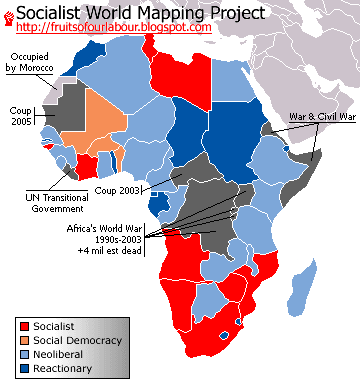
Socialist World Map Project - Africa

After much painstaking work, I have finally compiled the socialist map of Africa. Like the previous installment of the western hemisphere, this map displays countries color coded by their degree of socialism (see previous Socialist World Maps). This is based on the platform of the ruling party or coalition of the country in addition to historical tendencies.

Africa was very difficult. First there are a lot of countries in Africa, but more importantly, many nations of Africa are in terrible shape due to the "African World War" in adition to general strife and the legacy of colonialism and the slave trade.

Nevertheless, there is a surprisingly large Marxist community in Africa, with much being centered in south Africa. Ethiopia was a socialist country for many years, but the drought and civil war invovling Eritrea and Djibouti, as well as conflict with Somalia, led to total state collapse in the 1980s and 1990s.

Tunisia and Lybia are classified as socialist because their official government position and economic systems are largely socialist, and after speaking with an Arab friend who has travelled in both countries gave me some insight into what the cultures there are really like.

Socialist World Map - Africa

Monday, February 13, 2006

Papandreou Elected Head of Socialist International

"With your help, we will all work hard to keep the flame of social democracy burning. A flame of hope for this challenging world."

More than 350 leaders and representatives from some 110 political parties and organizations gathered in Athens for the Council meeting of the Socialist International (SI) on 30-31 January 2006.

Athens News Agency (ANA-MPA) reports (link here):
Athens, Jan 30, 2006. [...] George Papandreou was unanimously elected as the new president of the Socialist International, during a meeting here on Monday of the organisation's council.

Papandreou was the uncontested candidate for the position, following his official nomination by a SI working group, headed by Spanish Prime Minister Jose Luis Zapatero. The working group's recommendation was unanimously adopted in a show of hands vote.

In addressing delegates, Papandreou, the former Greek foreign minister, outlined what he called a vision for a better world and the central role that socialists have in such a prospect.

The PASOK leader cited an emphasis on greater freedom and democracy around the world, greater security, prosperity, equality and opportunities, but distinctly less poverty and hunger. "This will be a world that is more peaceful, with more cooperation," he said.

Papandreou added that the means humanity has at its disposal today can eradicate poverty, stop the "green house" effect, guarantee gainful employment, reduce infant mortality, improve healthcare, achieve equality between the sexes, include immigrants in local societies and stop the trafficking of drugs, weapons and people, among others.

Moreover, he outlined seven priorities for the organisation during his presidency, including:
  • "democratisation of globalisation", noting that it is impossible to "have true democracy in the world when there is a massive accumulation of capital and power in the hands of the few; when multinationals challenge the power of democratically elected representatives of the people; and when mass media is controlled by vested interests and big business"
  • Developing regional cooperation;
  • Uniting citizens in common action, saying that socialists must today "redefine the balance between productivity, social justice and freedoms", while he again voiced his support for the "Scandinavian model", as he said;
  • Relations between political parties and citizens;
  • Cooperation with the "society of citizens" and the creation of new alliances;
  • Gender equality, and finally,
  • Building peace around the world and resolving crises, especially terrorism.
"We won't eradicate terrorism unless we tackle the reasons that cause it (terrorism)," he underlined.

Saturday, February 04, 2006

Recommended (Socialist) Reading

Lately, I've been reading a lot which my comrades may find of interest. I find pleasure in reading, or media consumption in general, when 1) the content changes the way I thought about something, 2) when I learn something new, or 3) the content is entertainingly clever, which in my case tends to mean bitingly ironic social critique.

The January issue of the Monthly Review (Vol. 57, No. 8) contains three excellent and relevant cover stories all of which I highly recommend.

The first "The New Geopolitics of Empire" by John Bellamy Foster gives us the historical context of geopolitics and describes how it is being implemented today as explicit US policy, and specifically as constituted by PNAC and the Bush administration. The basic foundation of the theory is that all states are in constant competition with each other and must continually expand, both economically and militarily. The theory focuses on the geography of this realpolitik defining the geography as the stage. Sadly but not surprisingly, this is a very anti-humane worldview (states are the actors, not people) and further was a very influential concept with the Nazis.

The second is "What Will We Do?" by Ursula Huws. In part, this article is a discussion of individual identity as related to job categories and skill sets. This article also makes the argument that the current drive towards a "knowledge worker" global economy is, at its root, the creation of a global reserve army of labor. She describes historical trends to contextualize the current landscape of labor and touches on all the contemporary topics such as outsourcing and the heretofore decline of industrial unionism.

The third is "What Was The Matter with Ohio?" by James Straub. This fascinating article is an analysis of the shift in working class politics from the left to the right in the US, one outcome of which was Ohio going to Bush in the 2004 election (note: I am personally convinced that the evidence is more than complete to show that the Diebold voting machines had a lot to do with the election results). He describes how the evangelical churches have become a haven for a working class stripped of its jobs as industrial jobs are shed in Ohio by the hundreds of thousands. Straub tells the story of Ohio populism and progressive politics and its role as a catalyst for worldwide unionism, all of which has been devastated by the movement of industrial production to the Mad Max capitalism of the periphery areas, such as the Asian Rim. He quotes one of Karl Rove's strategists as describing the evangelical churches as the "new unions" - places where people find solidarity and where their politics are molded. Unfortunately these institutions are completely reactionary and focus the working class resentment along racial and gender lines. Not surprising considering they are largely funded by the ultra-right wing corporatocracy.

The Jan-Feb 2006 issue of ISR (International Socialist Review, Issue 45) has many interesting articles, a series of which focused on the California execution of Stan “Tookie” Williams changed my mind and opened my eyes. Especially relevant as February is “Black History Month” in the US, the articles tell the story of Stan Williams, his role in the Los Angeles gangs, arrest and conviction, and the incredible amount of work he did from jail to work to keep youths away from drugs and out of gangs. I encourage all to read the articles and (re)open your eyes to the truth of class warfare waged along race lines in America.

Finally, two book reviews from the Jan 13. Texas Observer (Vol. 98, No. 1) described a Texas I’d never know about – the Mexican-American radical communist-anarchists of El Paso at the turn of the last century (1890s-1920s). Ringside Seat to a Revolution by David Romo tells the story of El Paso during these times. Romo is a native of El Paso and he delves in the multiple micro-histories using psychogeographic techniques to weave a compelling and rich tapestry of a city experiencing dramatic social change.

In The Hummingbird’s Daughter, Luis Alberto Urrea is a novel, telling the story of his great-aunt Terresita Urrea, a famous healer and the Joan of Arc of the Mexican Revolution. Urrea was an inspirational figure in Mexico but had to flee to El Paso due to persecution by the Mexican Army. She was said to have healed over 10,000 people on one occasion, and many revolutionary fighters claimed that her apparition appeared during battles to lead them to victory.

Most of these articles should be available online, but I fully recommend subscription to any or all of the above mentioned publications.

Net Freedom Now

Some relevant propaganda, I encourage you to sign the petition:
What if …
  • AT&T and Verizon blocked you from viewing your favorite podcasts and blogs?
  • BellSouth cut off your net phone because you weren’t using their service?
  • Comcast forced you to download MP3s from their store while slowing other music sites?
This threat is more real than you might think. Right now, the major communications companies are planning to discriminate against the online content and services that they don’t yet control.
http://www.netfreedomnow.org