Showing posts with label Bolivia. Show all posts

Tuesday, September 23, 2008

When Fascists Attack


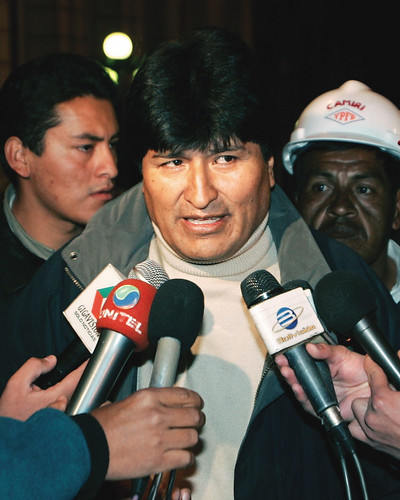
Fascist violence has been on the rise world-wide, with an outbreak of racists violence and murder spiking on September 11th in Bolivia. Hundreds of indigenous supporters of president Evo Morales, men, women and children, were beaten and whipped by racist gangs supported by the right-wing elites. In the worst attack, at least 30 campesinos were mowed down by machine gun fire while trapped on a bridge. Hundreds are still missing.

In other areas, fascists rioted in the streets, people were beaten and tortured, then forced to denounce Morales on their knees, dripping with blood, while they were recorded on video.

Bolivian fascist groups have been on the rise for several years, their level of violence increasing markedly in 2008.

What is the response from the Bush administration (with support from the US media)? To put Bolivia on the "narco-terrorist" list and call Evo Morales a "weak and desperate" leader. We can only expect more of the same from the war-monger McCain.

Say no to fascist racism! Say no to even tacit support of these thugs! Say yes to support of the rights of indigenous people, democracy and socialism!

From Green Left Weekly:
The violence was an attempt to impose by force what was lost at the ballot box.

Violently assaulting civilians, police officer and soldiers, occupying and burning public buildings, blowing up gas pipelines, and blockading roads were among the tactics of the pro-neoliberal forces of the opposition, which utlitised fascist shock troops of racist armed youth gangs, such as the Santa Cruz Youth Union (UJC).

The worst violence occurred on September 11, with the massacre in Pando of unarmed indigenous campesinos — including children and pregnant women — who were marching against the racist violence. It was carried out by paramilitaries created and controlled by Pando prefect Leopoldo Fernandez, since arrested over the atrocity.

At least 30 people were slaughtered, with more than 100 still missing.

Bolivia: Indigenous government defies US-backed fascists
From Worker's World:
Pando’s (Bolivia) prefect (governor) hired a gang of paramilitary criminals—some reports say from Brazil—who opened fire on a gathering of mostly Indigenous peasants on Sept. 11. As many as 30 people, all unarmed peasants, were killed near the capital city of Cobija. (BBC) This massacre was the most blatant crime in a series of attacks on buildings housing offices of the central government and popular organizations.

Facing fascist attack, Morales fights back
From the AP:
Gov. Leopoldo Fernandez of Pando province is being charged with genocide in what President Evo Morales calls an ambush of his supporters last week that left at least 15 dead and 37 injured.

Morales announced the arrest at a news conference Tuesday.

Bolivia governor arrested on genocide charges

Tuesday, November 13, 2007

Our 21st Century Zimmerwald

In September 1915 two coach loads of outstanding socialist leaders from the antiwar left wing of Socialist (2nd) International affiliated parties, including two future leaders of the October Soviet Revolution - Lenin and Trotsky -- met at Zimmerwald (in neutral Switzerland) to unite those revolutionary socialists prepared to carry out serious and consequent opposition to the imperialist world war. They issued a manifesto calling on soldiers, workers and oppressed peoples and nationalities of Europe to lay down their arms; and to refuse to continue to slaughter one another in the interests of capital; to struggle to defend their own class interests against those who had sent them to the trenches. In today's jargon we might say that the group was small enough to meet in a rented Tim Horton's, but too big to meet in a telephone booth (as do quite a number of ultraleft groups today when they congregate to cross more t's and dot more i's on their manifestos denouncing Chávez and Morales as a mealy-mouthed "populists").

The solid core of the Zimmerwald group, despite its small size, went on to lead the Russian October revolution. Under the impact of Soviet power in the former Tsarist Empire, the capacity of the German and other ruling classes in Europe to continue their carnage and slaughter dissipated. Kings, Kaisers, and Tsars were toppled as the "war to end all wars" collapsed amidst mutinies, rebellions, civil wars, and insurrectionary commotion across the "Old Continent." The rebellious mood even spread to North America as the Winnipeg General strike of 1919 showed.

From Santa Clara (Cuba) -- today's 21st Century Zimmerwald -- tested Cuban and Venezuelan leaderships wielding government and state power set forth a clear orientation to millions of anti-imperialist, anti colonialist, and anti-capitalist fighters across the continent. Hugo Chávez made it clear that they and their allies will not back down in the face of imperialist threats. And they will not stand idly by - Chávez iterated this with utter clarity - and allow imperialist inspired forces to overthrow the Bolivian government and/or assassinate Bolivian President Evo Morales. The great moral authority of el Che - Ernesto Che Guevara - accompanied that of Fidel Castro and Hugo Chávez to add force and depth to the message.

Our 21st Century Zimmerwald. VenezuelaAnalysis.com. 14-Oct-2007.

Friday, October 12, 2007

Viva Che!

Remembering Che Guevara on the anniversary of his death as a true hero. Che had a deep love of the masses coupled with hatred for those who callously exploit them. In Latin America, now as then, the class divide is markedly visible. It is no wonder that this is the terrain where 21st socialism is gaining ground.

A previous post on this blog from 2005 titled Che's Ride offers a review of the Motorcycle Diaries, a semi-biographical film about Che.

Following is an edited excerpt from an article by Peter Taaffe on Socialistworld.net this month, October 2007.
[...]

Like millions throughout the world, we [Marxists] hailed his heroic efforts in combating capitalism and imperialism. Che Guevara was and remains an enduring symbol of implacable resistance to a destructive and wasteful system, and the inevitability of a revolt against it by its victims. What a contrast between Che Guevara and the politically bankrupt and cowardly misleaders of the labour movement today!

As Tony Saunois's analysis published recently on socialistworld.net demonstrates, Che Guevara was not a 'plaster saint'; he made mistakes. But he was also capable of reassessing his actions and learning from them.

[...]

Che Guevara, at the time of his death, was an increasingly vocal critic of Stalinism, which he began to reject after he had visited the 'Eastern bloc'. He read Trotsky and had a book by Trotsky in his belongings when he was murdered. Moreover, the charge of 'wanting a nuclear holocaust' because he supported nuclear missiles being installed in Cuba is false to the core. Does every capitalist government that supports nuclear weapons for 'defence' do this because they want to unleash a nuclear holocaust? Merely to pose the question shows how absurd is the charge that [some] has levelled against Guevara.

The Cuban revolution from the outset was besieged by imperialism. It had just experienced the CIA-sponsored 'Bay of Pigs' invasion. It was, therefore, entirely understandable for Fidel Castro and Che Guevara to seek to defend, through the acquisition of arms, the gains of the revolution.

There is a discussion to be had as to whether it was tactically wise for Fidel Castro and Che Guevara to support the installation of nuclear weapons in Cuba. They honestly believed it was necessary for the defence of Cuba but the real ultimate defence of the Cuban revolution was in the mass support in Latin America and worldwide.

[...]

The tragedy of Che Guevara is that he was assassinated while he was still developing his ideas. We supported this heroic figure in his combat against imperialism. But, at the same time, we pointed to some of the deficiencies in his 'guerrillaist' strategy, counter-posing to this the social role of the mass working class of Latin America.

The reprinted article below shows the consistent attitude of Marxism towards Che Guevara, not ex-post facto, but at the time of his death and since.

Taaffe, Peter. Latin America - Marxism or Guerrillaism? Socialistworld.net, 2007 (reprinted article c. 1968).

Monday, January 23, 2006

Lenin On Bolivia

Lenin at leninology.blogspot.com wrote an excellent post on Bolivia today. An excerpt follows, but I encourage you to read the whole thing:
Curiously enough, while much was made of Bachelet's victory in Chile introducing the first woman president to the country, comparatively little has been said about the fact that Morales is the first Indian president in Bolivia. It isn't that Bachelet's being a woman is insignificant - it just may be the only significant thing about her victory. Whereas Morales background intersects with the whole variety of reasons why he was elected. In short, this is the first Indian political leader Bolivia has had, in a country with an Indian majority, since Spanish colonialists conquered the area in 1525. It was the Indian population that provided an army of slave labourers to augment the "international help" in exploiting the silver mines. It was the colonial elite that controlled the country even after the colonists had been kicked out in 1809 - and a weak elite it was, too, susceptible to invasion and the loss of territory on all sides. It is fairly safe to say that this elite would have been dispatched a lot more rapidly and properly buried had it not been for US intervention. For although the Nationalist Revolutionary Movement had, following the 1952 revolution in which it ousted much of the old landed oligarchy and expropriated the mines, begun the process of consolidating the rule of the domestic middle class, it did create the conditions in which dual power could subsist. That was terminated by a CIA supported military coup in 1964, which saw Rene Barrientos take power until 1969, during which time miners had their wages cut and were massacred at Catavi. There was a short-lived left-nationalist regime under Gen. J.J. Torres in which workers's self-government was created in a popular assembly, and - yes - that too was supplanted after a mere two years by yet another CIA backed coup in 1971. General Banzer, after seven years of rule, was followed by a succession of military dictators known for their corruption, illicit narco-trafficking, and extraoardinary brutality. Subsequently, a sequence of liberalising governments allowed the country's nationalised assets to be bought off in large chunks by foreign investors - the so-called 'capitalisation' programme. Gen. Banzer won power electorally in 1997, with a mere 22% of the vote, and proceeded to crack down hard on the coca growers whose militancy had dogged previous governments, privatise industry, and renege on his pledge to suspend the privatisation of the oil company. All in accordance with the wishes of Washington. In 2001, he gave way to a former IBM employee, who in turn gave way to another 'technocratic' neoliberal. However, by then the genie was out of the bottle again - in 1998, the World Bank refused to guarantee a loan to finance water services in Cochabamba unless the utility was privatised and the costs passed on to consumers. In 1999, consortium led by Bechtel won the contract, and immediately doubled the price of water, which meant that for many it cost more than food. The World Bank kindly announced that it supported the full-cost pricing and declared that none of its loan could be used to subsidise water for the poor. In 2000, mass strikes and demonstrations broke the government and Bechtel were ordered out.

More here...

Monday, January 16, 2006

A Speech from a Real President

We in the USA have been inflicted with many presidents over the years. We have heard many speeches and learned in school and from the media that American democracy is "of, by and for the people." We learn from our president about "freedom" and the importance of "patriotism" although we are often left not quit sure what those things are. We are subjected to the lunatic gibbering of lunatics on a regular basis when our presidents are asked to engage in intellectual debate. We had a man with Alzheimer, albeit a tragic disease, representing us as our leader and literally worshipped as a national hero (even though he went by the nickname "Dutch," oddly enough). We have a president who refers to the richest 1% of the nation as "his base" with glee while sending the less fortunate to be ground into hamburger overseas (although as presidents go, he is far from unique in this regard, war and kowtowing to capital are national pastimes for American presidents).

So, ever wonder what it would be like to have a real president? One who had convictions he could intelligently elaborate upon? One who took representing "the People" seriously?
"Evo, what do you and the MAS understand by 'socialism,'" I asked him, when I was invited by the Executive Committee of the Bolivian Labor Central (COB). "To live in community and equality," he answered. "Fundamentally, in the peasant communities they have socialism. For example, if we speak of land. I come from the ayllu of the Department of Oruro. Clearly, where I live at this moment, in the East in Chapare, there are no ayllus. It is individual parceling, and there arise very serious problems, because it leads to small holdings, which you don't see in a peasant community where the land is communal."

"Does the socio-economic model of the MAS resemble more that of Lula, Cuba, or Hugo Chávez?" I insisted. "I believe it is something much deeper," he answered. "It is an economic model based on solidarity, reciprocity, community, and consensus. Because, for us, democracy is a consensus. In the community there is consensus, in the trade union there are majorities and minorities.

"Inside this official democracy of Bolivia they do not respect the thought, sentiments, and the sufferings of the national majorities. And within this framework we are seeking a communitarian socialism based on the community. A socialism, let's say, based on reciprocity and solidarity. And beyond that, respecting Mother Earth, the Pacha Mama. It is not possible within that model to convert Mother Earth to merchandise. In Bolivia with the agrarian reform it is better to be a vaccinated cow than a human being. For a vaccinated cow there are 25 hectares and for a human being there is nothing."

Read more here...

Evo Morales, Communitarian Socialism and the Regional Power Block
By Heinz Dieterich
Jan 14, 2006, 18:12

Friday, January 13, 2006

Bolivia Elects Socialist President


Evo Morales and the MAS (Movement Towards Socialism) party have come into power in Bolivia.
This is another case of people power achieving what was once thought to be impossible.

A few years ago Bolivia was firmly controlled by right-wing neo-liberals. Extensive privatization was occurring. Petroleum was being pumped out of the country at an incredible pace, while the local population was left with no fuel or sky high prices, and no share of the profits.

International parasites mostly based in the USA and backed by onerous IMF policies, had descended on Bolivia to take over previously state-owned operations. They went so far as to "offer" privatized water and laws had been passed making it illegal for people to collect and drink rainwater (forcing them to pay for this ubiquitous resource).

Their reign is over. With strong ties to Hugo Chavez and the ever increasing momentum of class awareness in South America, we can watch with great expectation for Morales to roll back the reactionary policies of the IMF and pro-business policies of his predecessors.

Political Affairs Magazine reports:
In the 18th December 2005 Bolivian presidential elections Evo Morales received 53% of the vote -- 1,158,431 out of the 2,185,960 votes cast. His Movement Towards Socialism (MAS) defied media predictions that he would obtain only 35% of the vote -- which would have left the Bolivian parliament to decide on who the new president would be.

Podemos, the main right wing, pro-IMF and pro-US party, led by Harvard-trained Jorge Quiroga received 30% of the vote. With the Movimiento Indigena Pachakuti’s (MIPI) vote, the left parties together secured 55% of the vote. When we consider the scandalous exclusion of 1,000,000 voters from the electoral register – people who happen to live mainly in MAS strongholds -- then the defeat of Bolivia’s pro-neoliberal forces takes on an even greater significance. The MAS also did extremely well in the parliamentary elections.

In his election campaign manifesto Morales included measures with wide popular support such as the legalisation of coca leaf production and the nationalisation of the gas industry.

Evo Morales will become the second president of indigenous background in the history of Latin America. (The first was Benito Juarez, in Mexico during the second half of the 19th century). A new page has opened in the history of Bolivia, where the election of Evo Morales to the presidency means that the country’s majority indigenous population (60% of the population) have an historical opportunity of beginning to redress the centuries of exclusion, discrimination, poverty and brutal exploitation to which they have been subjected by the dominant white elite.

Read more here...