Showing posts with label Labor Day. Show all posts

Thursday, May 01, 2008

Longshoremen May Day Strike

Happy May Day!
“We’re standing up for America, we’re supporting the troops, and we’re telling politicians that it’s time to end the Iraq war now!” longshore union workers say.

More than 25,000 longshore workers at 29 west coast ports are exercising their First Amendment rights today by taking a day off work and calling for an end to the war in Iraq.

“Longshore workers are standing-down on the job and standing up for America,” said ILWU International President Bob McEllrath. “We’re supporting the troops and telling politicians in Washington that it’s time to end the war in Iraq.”

McEllrath says rank-and-file members made their own democratic decision in early February when Longshore Caucus delegates voted to take action on May 1. Employers were notified of the plan, but refused to accommodate the union’s request despite plenty of advance notice. The employer group, represented by the Pacific Maritime Association (PMA) consists of large carriers and port operators, most of which are foreign-owned.

“Big foreign corporations that control global shipping aren’t loyal or accountable to any country,” said McEllrath. “For them it’s all about making money. But longshore workers are different. We’re loyal to America, and we won’t stand by while our country, our troops, and our economy are destroyed by a war that’s bankrupting us to the tune of 3-trillion dollars. It’s time to stand up, and we’re doing our part today.”

01-May-2008. Dockworkers protest Iraq war, stay off job on May 1. People's Weekly World Newspaper.

Thursday, March 17, 2005

May Day Parade to be Led by Bernie Sanders

AMERICA’S only socialist congressman is to lead this year’s May Day parade through Edinburgh, Scotland.

Bernie Sanders, who sits for the state of Vermont in the US House of Representatives, is one of his country’s most outspoken critics of the war in Iraq. And he has led opposition to a spate of corporate scandals rocking America.

Congressman Sanders says he champions "the cause of ordinary hard working American families". More on this story here.

On May 1 the world working class and labour unions display their strength in demonstrations and strikes. May Day "International Workers' Day" is a reminder to the ruling classes that the days of Capital are numbered.

May Day was born from the struggle for the eight-hour work day, and is recognized around the world as a working class holiday, a day of solidarity between workers of all nationalities; a celebration universally feared and resented by the captains of finance and industry.

The seeds were planted in 1791 in Philadelphia where the carpenters first struck for a ten-hour work day. By the 1830s the ten-hour day became a general demand with workers struggling against 12+ hour days.

The American Civil War eliminated slavery in the United States and gave momentum to labour agitating for fair working hours. Marx noted that "out of the death of slavery a new life at once arose. The first real fruit of the Civil War was the eight-hours' agitation, that ran with the seven- leagued boots of the locomotive from the Atlantic to the Pacific, from New England to California."

By 1872 Six years later, in 1872, a hundred thousand workers led by the Knights of Labor in New York City struck and won the eight-hour day, mostly for building trades workers. It was in this rising ferment for the eight-hour day that May Day was born.

The catalyst was The Haymarket incident in Chicago, where hundreds of police clashed with IWPA demonstrators over several days, resulting in deaths on both sides. The anarchist leaders if the IWPA were treated to a show trial and, lacking evidence, where murdered by the state for their beliefs. All were posthumously pardoned.

The AFL (American Federation of Labor) convention in 1888 announced that May 1, 1890, would be a day when labor would enforce the eight-hour day with strikes and demonstrations. Ironically, in 1905 after decades of rightward drift, the AFL had disavowed May Day altogether, celebrating instead Labor Day on the first Monday of September, a celebration sanctioned by the US federal government in 1894 (see Mar 4, How Labor Won Its Day).

Summarized from various sources including Liberation & Marxism, issue no. 27, 1996. L&M, 55 W. 17 St., 5th Fl., NY, NY 10011; via e-mail: l&m@wwpublish.com. Web: http://www.workers.org

Saturday, March 05, 2005

How Labor Won its Day


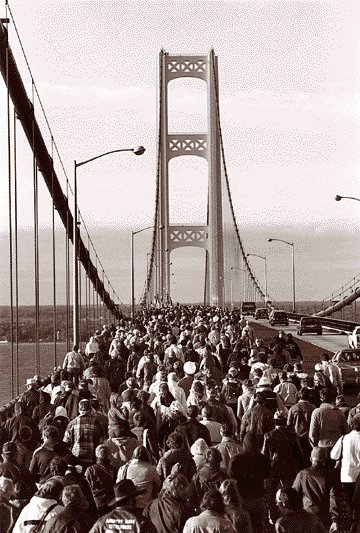
The Labor Day march across the Mackinac Bridge led by Michigan's governor. This photo comes from the Detroit News article "How Labor Won Its Day," which inspired the title of my blog. This is an abstract from that article (By Patricia K. Zacharias / The Detroit News):

History has almost forgotten Peter McGuire, an Irish-American cabinet maker and pioneer unionist who proposed a day dedicated to all who labor. Old records describe him as a red-headed, fiery, eloquent leader of the Brotherhood of Carpenters and Joiners.

McGuire introduced his idea formally at a meeting of the Central Labor Union on May 18,1882. "Let us have, a festive day during which a parade through the streets of the city would permit public tribute to American Industry," [my emphasis rir] he said.

The following September New York workers staged a parade up Broadway to Union Square. Few, if any, workers got the day off. Most were warned against marching in the parade with the threat of getting fired. Despite the warning, more than 10,000 workers showed up for the march. Led by mounted police, bricklayers in white aprons paraded with a band playing "Killarney." The marchers passed a reviewing stand crowded with Knights of Labor: a holiday was born. McGuire's holiday moved across the country as slowly as did recognition of the rights of the working man.

Twelve years later, on June 28, 1894, President Grover Cleveland, long a foe of organized labor, but under voter pressure, signed a Labor Day holiday bill. Earlier that same year, President Cleveland's most famous labor conflict, the Pullman strike in Chicago, had forced the president to call up federal troops. Employees of the Pullman Co., which produced sleeping cars for passenger trains, protested wage cuts. Led by Eugene V. Debs, the American Railway Union (ARU) in sympathy refused to haul railroad cars made by the company. A general railway strike ensued, interfering with mail delivery. When the ARU refused a court order to return to work, Cleveland sent in federal troops. "If it takes the entire army and navy of the United States to deliver a postal card in Chicago, that card will be delivered," he said. Rioting broke out: strikers were killed and leaders jailed, but even as the strike was broken, the labor movement gained steam [thereby forcing Cleveland's hand rir].

See the full article here.