Wednesday, May 28, 2008

Alvaro Uribe's Laptop Lies

It seems Colombian President Uribe's government is playing favorites when it comes to rebels, warlords and laptops. Perhaps his own allies dealings in drug trafficking would have been exposed if these laptops were open to public scrutiny.

Why on earth were known criminal, murdering, drug-dealing warlords - men known to have ordered the murders of thousands - even given laptops, blackberries etc. while in prison?

Perhaps because Uribe is and always has been involved with these drug dealers (at least according to the US intelligence community):
The release of a 13-year-old previously classified military intelligence document linking Colombia’s right-wing president Alvaro Uribe to drug traffickers has intensified the crisis of Washington’s most slavish supporter in Latin America.

A virtual “who’s who” of the Colombian cocaine trade, the report was issued by the Defense Intelligence Agency (DIA) in 1991. It was obtained under the Freedom of Information Act by the National Security Archives, a non-governmental research group based at George Washington University.

The document lists 104 of the “most important Colombian narcoterrorists contracted by the Colombian narcotics cartels for security, transportation, distribution, collection and enforcement of narcotics operations in both the US and Colombia.” Uribe appears as number 82 in this list of assassins and drug smugglers.

The confidential DIA report described Uribe in the following terms: “A Colombian politician and senator dedicated to collaboration with the Medellín Cartel at high government levels. Uribe was linked to a business involved in narcotics activities in the US. His father was murdered in Colombia for his connection with the narcotics traffickers. Uribe has worked for the Medellín Cartel and is a close personal friend of Pablo Escobar Gaviría.” It added that Uribe had “attacked all forms of the extradition treaty” that Washington had sought to bring Colombian drug traffickers to trial in the US.

Van Auken, Bill. 05-Aug-2004. Colombia’s Uribe: US ally in “war on terror” named as drug trafficker.
Meanwhile the international press is eager to jump on any "evidence" Colombia releases which discredits FARC or any other leftist.

The corruption is disgusting.

From the AP:
BOGOTA, Colombia (AP) -- Laptop computers have proven evidentiary treasure troves of late for Colombian investigators probing far-right militias and leftist rebels.

So it amazed many to learn that authorities did not immediately secure the laptops and cell phones belonging to most of the 14 paramilitary warlords they yanked out of prison on May 12 and extradited to the United States to stand trial for drug trafficking.

The hard drive in warlord Ramiro Vanoy's laptop and three cell phone SIM cards - which store phone numbers and text messages - went missing from Itagui prison outside Medellin, where half of the extradited warlords were held.

And prosecutors are not yet able to say whether any of 10 seized computers were tampered with during the more than 48 hours that lapsed before prison officials handed them over to judicial investigators.

The apparent neglect - or worse - was especially striking given officials' recent handling of evidence found on other laptops.

[...]

"It's sabotage of important evidence, though you don't know whether it's ineptitude or done deliberately," Lopez said in a telephone interview.

After an uproar in Colombian media about the mishandled equipment, Vanoy's lawyer turned over on Friday what he said was the errant hard drive, "its seals of guarantee perfectly intact," according to the national prisons authority.

[...]

The laptops' presence in prison owe to their owners' unusual situation: the warlords surrendered under a 2003 peace pact that offered them reduced prison terms in exchange for their full cooperation in confessing to crimes. Many were using the machines to compile details of their transgressions.

[...]

Mancuso has implicated more politicians and military officers than any other paramilitary boss as criminal accomplices of the warlords, who seized control of Colombia's Caribbean coast beginning in the late 1990s, killing thousands and stealing millions of acres of land.

Many believe Mancuso had information in his laptop that could have incriminated more of his partners in crime and correctly suspected his extradition could be imminent when President Alvaro Uribe extradited a first paramilitary warlord on May 7 after receiving a court's go-ahead.

[...]

Chief Prosecutor Mario Iguaran's office provided the following update Tuesday on the paramilitaries' legacy: 1,492 bodies of victims have been recovered from common graves and demobilized fighters have confessed to 5,841 crimes.

It said it believes another 4,000 common graves remain to be unearthed.

Bajak, Frank. 28-May-08. Warlords' laptops: not handled with care. Wired News.

China in Africa by Richard Behar

China is leveraging its Communist political legacy and 3rd world status, as well as its surging financial muscle, to compete head-to-head with the Western neo-colonials in Africa. Specifically China has gotten in on the resource grab for oil, timber, copper and other minerals which the US and European powers have been engaged in for well nigh a century.

There are signs, depending always on the quality of the local leadership, that the overall model may have longer lasting positive effects such as infrastructure and hospital projects, there are signs that China is even more exploitative of the African workers than the Westerners.

This is the most disturbing aspects, that China is using its credentials as a nation exploited by Western colonizers to gain leverage with African nations sharing a similar history. However, based on this article, it is not applying socialist principles to those efforts but instead applying the most brutal capitalist exploitive model possible on the ground against local workers. Behar even suggests that there are reports that Chinese workers imported to Africa are convicts, essentially slave labor.

This is especially sad in the case of countries like Zambia where during the 70s workers enjoyed cradle-to-grave security based on an extensive welfare state funded by nationalized mineral wealth, a model the western powers could not abide for long and one that the Chinese government, at least for now, seems uninterested in resurrecting.

Below is an excerpt from an incredible article by the tenacious journalist Richard Behar which appeared in, of all places, Fast Company magazine. I highly recommend you take the time to read the article:
[...]

An unfathomably vast terrain comprising 49 nations, the sub-Sahara represents nearly one-fifth of the earth's landmass. Yet its total economy is tinier than Florida's. Here, 300 million people get by on less than $1 a day. Until they don't: It is the planet's biggest tomb, where compared to the 1960s, twice as many children under the age of 5 are now dying each day from disease; a bottomless badland where $500 billion of Western aid since World War II (more than four Marshall Plans) has barely made a dent in the poverty; a region whose market share of world trade is shrinking by the hour as it gets left behind, perhaps permanently, in the dust of globalization; a place so desperate for everything -- cash, trade, investment, infrastructure -- and so powerless to negotiate strategically, that it's pretty much up for sale to the highest bidder.

[...]

In describing China's exploits, it's tempting to evoke the image of a benign, postcolonial West being outfoxed by a ruthless and unscrupulous neo-communist power. Don't bother. The American track record in modern Africa has been deplorable -- a half-century of backing strongmen, turning a blind eye, and taking what we can get with little or no regard for the health or welfare of the locals. So no, this is not an update about the Yellow Peril, although no shortage of U.S. officials see China's safari as precisely that. Instead, this is a story about an economic model of exploitation that is at once formidably efficient and tragically flawed, about a planet that's being consumed by those who live on its surface. Today's global economy has an insatiable need for raw materials. That's as true for China's rise as it is true for the maintenance of America's economy. With China exporting some 40% of its GDP, Americans need to understand that behind that Made in China tag at Wal-Mart is a mutually reinforcing death spiral. We are beginning to overwhelm our host.

[...]

Equatorial Guinea is less a country than a corrupt, extended-family business that cooked up its own national anthem. And the American oil industry has been singing along for years, cuddling up as much as necessary (and with barely any competition) to Teodoro Obiang Nguema Mbasogo, the 66-year-old despot who has ruled this backwater since 1979. Smaller than El Paso, Texas, E.G. has nevertheless managed to get itself at or near the top of just about every shameful list in the world -- from the most-censored countries (according to the Committee to Protect Journalists) to the most corrupt (Transparency International) to the worst places to do business (the World Bank). Geoffrey Wood, a business professor at the U.K.'s University of Sheffield and coauthor of The Ethical Business, concluded in his own 2004 study of E.G. that the country is a "criminal state" that matches or exceeds the "rapacity and brutality" of the Duvaliers' Haiti, Somoza's Nicaragua, and Batista's Cuba. Despite an economy with the highest average annual growth rate in the world (21%) since 2001, more than half of the population lacks access to potable water and electricity. The UN says E.G. shows the greatest disparity on earth between per capita income ($50,000, surpassed only by Luxembourg) and human welfare (most of E.G.'s citizens live on less than $1 a day).

Behar, Richard. June-2008. China in Africa: Part I. Fast Company.

Thursday, May 01, 2008

Longshoremen May Day Strike

Happy May Day!
“We’re standing up for America, we’re supporting the troops, and we’re telling politicians that it’s time to end the Iraq war now!” longshore union workers say.

More than 25,000 longshore workers at 29 west coast ports are exercising their First Amendment rights today by taking a day off work and calling for an end to the war in Iraq.

“Longshore workers are standing-down on the job and standing up for America,” said ILWU International President Bob McEllrath. “We’re supporting the troops and telling politicians in Washington that it’s time to end the war in Iraq.”

McEllrath says rank-and-file members made their own democratic decision in early February when Longshore Caucus delegates voted to take action on May 1. Employers were notified of the plan, but refused to accommodate the union’s request despite plenty of advance notice. The employer group, represented by the Pacific Maritime Association (PMA) consists of large carriers and port operators, most of which are foreign-owned.

“Big foreign corporations that control global shipping aren’t loyal or accountable to any country,” said McEllrath. “For them it’s all about making money. But longshore workers are different. We’re loyal to America, and we won’t stand by while our country, our troops, and our economy are destroyed by a war that’s bankrupting us to the tune of 3-trillion dollars. It’s time to stand up, and we’re doing our part today.”

01-May-2008. Dockworkers protest Iraq war, stay off job on May 1. People's Weekly World Newspaper.

Tuesday, April 15, 2008

300,000 March in Support of Chavez

While the capitalist press runs stories about small protests against Chavez in various parts of the world, on April 11th, over 300,000 march in support of the socialist revolution in Caracas:
Under the banner, “Never again will the people be betrayed,” some three hundred thousand people rallied outside the Miraflores presidential palace in Caracas on Sunday in a massive show of support for Venezuelan President Hugo Chavez. The rally was held to celebrate the anniversary of the popular uprising that defeated a US-backed opposition coup from April 11-13 in 2002, and restored the democratically elected Chavez to power.

Janicke, Kiraz. 15-Apr-2008. Massive Show Of Support For Venezuelan President Chavez On Coup Anniversary. VA.

Why Did William Fallon Resign?

The commander of U.S. forces engaged in Iraq and Afghanistan resigned Friday. He was denied testifying along with General Petraeus and Ambassador Crocker to Congress. Why? He disagreed with the Bush Administration and publicly stated that there would be no war with Iran "on his watch."

From the Voice of America:
The commander of U.S. forces in the Middle East, Central Asia and East Africa stepped down Friday, after just a year in command, following allegations he had disagreed with the Bush Administration on some key policies. VOA's Al Pessin reports from the headquarters of U.S. Central Command in Tampa, Florida.

It was the last day in command for Admiral William Fallon, and it came several months earlier than expected. The Florida sunshine, dress uniforms and upbeat music could not mask the fact that this ceremony was not expected to happen until later in the year, or even next year. That changed when Admiral Fallon was depicted in an Esquire magazine article earlier this month as the only man standing between the United States and war with Iran.

Indeed, Admiral Fallon did say several months ago that war rhetoric from some members of the White House staff was not helpful in his effort to ease tensions in the Middle East. And he has publicly opposed some other key policies, including, initially, the surge of U.S. forces into Iraq.

Pessin, Al. 28-Mar-2008. US Middle East Commander Steps Down After Controversy. Voice of America.

Monday, April 14, 2008

After Long Struggle, Maoists Win in Nepal


From Asia Times, M K Bhadrakumar:
The South Asian political landscape will never be the same again following the Maoist victory march in Nepal's elections to a new 601-seat constituent Assembly last Thursday. It may take several days before the election results are fully known, but available trends indicate that the Communist Party of Nepal (Maoist) is surging ahead. By Monday, the Maoists had secured 89 of the total declared 162 seats for which results were declared.

The established mainstream parties, such as the Nepali Congress and Communist Party of Nepal (Marxist-Leninist) are trailing far behind. The royalists, who rooted for the perpetuation of the 240-year-old Hindu monarchy, have been routed. A distinct possibility arises that the Maoists will secure a simple majority and lead the next government - an extraordinary feat for the former rebels who gave up a decade-long armed struggle and took to the democratic path hardly two years ago.

The impact is bound to be far-reaching on Nepal's political economy, South Asia's political landscape and the geopolitics of the region. Thursday's elections are primarily aimed at forming a constituent assembly to determine the contours of Nepal's political system. The results signify that the country is irrevocably set on the path of republicanism. Even the limited role of a constitutional monarchy seems out of the question.

The results signify pervasive popular disenchantment with the established political parties. Most expert commentators have to explain their lapse in not foreseeing such an outburst of popular opinion. Clearly, the people have voted for change. The groundswell of support for Maoists is fairly widespread, cutting across regions. Claiming victory, Maoist leader Pushpa Kamal Dahal (popularly called Prachanda) said his party's victory was a mandate for lasting peace, implementation of the democratic republic and rapid economic development. He frontally addressed the intriguing question: "People are asking, 'What is this Maoist party?' And the international community is asking, 'What will happen after the Maoists win?' All these fears are unnecessary."

Prachanda held out the assurance that his party's agenda would be to work with other political parties during the transition period. "We will establish greater national unity with all political parties after the election," he added. The Maoists received commendation from an unexpected quarter when former US president Jimmy Carter, who led a team of foreign observers, stated at a press conference in Kathmandu on Saturday his conviction that the former rebels were every bit wedded to the democratic path.

The poorest country in South Asia has suddenly catapulted itself to the vanguard of democratic reform and political transformation in the region. India, which basks in the glory of its democratic way of life, at once looks a little bit archaic and tired in comparison. After 60 years of uninterrupted democratic pluralism, vast sections of Indian society are yet to realize the potentials of political empowerment. The Nepalese people have come from behind and overtaken the Indians in expanding the frontiers of "bourgeois" politics.

Politics in India still meander through alleys of caste and parochialism and eddies of religious obscurantism and Hindu nationalism. The upper-caste Hindu elites in Nepal used to share social kinships with the Indian political elites. The Maoists have upturned Nepal's entrenched caste politics. The Indian electorate is yet to explore in full measure ideology-based secular political empowerment, which is the bedrock of democratic self-rule. Unsurprisingly, India's main opposition party, the right-wing Bharatiya Janata Party, which thrives on Hindu fundamentalism, has been stunned into silence. It feels let down that a country that it dearly cherished as the world's only "Hindu kingdom" has taken to secular democracy with such panache.

The Maoist government will proceed to dismantle the pillars of Nepal's feudal structure and will take recourse to radical economic and political reforms based on distributive justice and egalitarian principles. That is bound to catch the attention of impoverished Indians in the sub-Himalayan belt sooner or later. The Indian states (provinces) bordering Nepal are notorious for their misgovernance.

The Maoist victory in Nepal poses a challenge to the Indian establishment as well. Delhi is distinctly lukewarm about the prospect of an outright Maoist victory. The Indian establishment traditionally works with the Nepali Congress. Some elements within the establishment view with disquiet the prospect of the Maoists galvanizing revolutionary movements within India. Conceivably, Delhi didn't anticipate a tidal wave of popular will favoring the Maoists in Nepal.

All the same, Delhi allowed the democratic process in Nepal to take its course. It could not but take a keen interest in Nepalese politics and a completely "hands-off" approach was unrealistic to expect, but the real question was of not being intrusive to the point of interfering in Nepal's internal affairs. In the event, Delhi kept cool and maintained a delicate balance - watching developments closely while keeping a decent distance and reserving options to adapt to circumstances. However, a period of adjustment to the new political realities in Kathmandu becomes necessary and a thorough revamping of policy directions is inevitable. Nepal is far too important a neighbor for India. Its rapidly growing relations with China add to Delhi's policy calculus.

China's policy towards Nepal is not ideology driven insofar as Beijing kept in view the imperatives of inter-state relations almost until the end of King Gyanendra's direct rule. But Beijing swiftly adapted to the emergent democratic forces in Nepal with great pragmatism and forged working relations with all political parties, including the Maoists. China's interest in Nepal has increased almost exponentially. The overarching geopolitical reality is that the United States has become hyperactive in Nepalese politics. The developments in Tibet have added a further dimension. Tibetan activists in Nepal have been particularly strident.

Much depends on Prachanda's priorities. The Maoist leader has time and again shown he is not a dogmatist wedded to textbook Marxism and will give primacy to the implementation of his reform agenda. He has proved to be a brilliant tactician. He will tap into all available goodwill in Delhi and Beijing to the extent that his agenda of Nepal's rapid economic development benefits.

In his first post-election comments, Prachanda said Nepal will develop "new relations" with the Indian leadership. He stressed the close cultural and historical links between the two countries and pointed out it is "quite important" to have good neighborly relations with India. "A good understanding with Delhi can create a new basis of unity with India," he said.

But he clarified that Nepal will maintain equidistance between India and China in political terms. Beijing is certain to respond to him, given the criticality of Nepal to Tibet's security and stability. If China's Central Asia policy is anything to go by, it will put big money on the table in Nepal in the coming period so as to keep at bay the three "evils" - terrorism, religious extremism and separatism.

Besides, Nepal is resource-rich. There are any number of areas such as development of infrastructure, hydroelectric power or the manufacturing industry, where Nepal offers attractive business opportunities for enterprising Chinese firms. Nepal can also be a gateway to the Indian market.

The advent of the Maoists to power in Kathmandu, therefore, confronts Delhi with a creative challenge. The old days are gone when Delhi could take a complacent view that come what may, Kathmandu would remain wedded to cultivating Indian goodwill. The need arises now for Delhi to be proactive, efficient and competitive. China's "soft power" in Nepal is already very considerable, while Nepal is no exception to the latent "anti-Indianism" common to India's neighboring countries.

Any Indian assumption that Nepal is its security backyard or that it should be within India's "sphere of influence" will be untenable. If Delhi resorts to pressure tactics, sensing that the Maoists have a long way to go to consolidate their grip on political power, it might prove counterproductive.

On the other hand, the lengthening shadow of Chinese influence in Nepal should act as a spur goading India into creative diplomacy. Having said that, India is still left with vast leverage over Nepal spread over several inter-locking planes - geography, culture and common ethos, shared history, economic and social linkages, etc - and there is no real need to panic.

Almost certainly, the Maoists will want to jettison the 1950 treaty of peace and friendship with India, which they consistently viewed as an unequal framework. Equally, Delhi is conscious of the treaty's growing irrelevance, even though the treaty provides significant trade and transit advantages to landlocked Nepal and the Maoists, once in power, may come to better appreciate that. No doubt, the renegotiation of the treaty will bring to the fore the new impulses of the three-way equations involving India, Nepal and China.

Nepal has proved to be an unhappy experience for the United States and India in their newfound interest to coordinate and harmonize their regional policies. While India managed to keep its options open in a developing situation, the US policy finds itself in a cul-de-sac. It was predicated on the naive belief that Nepal could be made a geopolitical pressure point on China's soft underbelly. Nepal becomes the latest link in the chain of the George W Bush administration's foreign policy misadventures. The Maoists of Nepal still figure in the US State Department's list of terrorist organizations.

But Prachanda may offer Washington an exit strategy without loss of face. Responding to the media on Sunday, he said, "Yesterday, I had a very serious discussion with former US president Jimmy Carter, and I raised this question [of Washington regarding the Maoists as terrorists] ... It seems ridiculous to me."

M K Bhadrakumar. 15-Apr-2008. Nepal triggers Himalayan avalanche. Asia Times.

Saturday, April 12, 2008

The Great Unwind has begun

Note the word "begun." For all the talk of bulls and bears, when you get warnings like this from the biggest bank in the world, you can bet your life that the market has not bottomed, no matter what CNNfn and the host of TV idiots have to say about it.

If you are lucky enough to actually have a retirement account I have one word for you: TIPS. In other words, move your savings into an inflation-linked bond vehicle.

In an article characterized by Marketwatch as a "death-bed confession", Citibank warns on coming recession and massive shakeups in the financial world:
As markets and economies de-leverage across the globe, investors should avoid companies and countries that have grown to rely too much on borrowed money, they said.

That means favoring public-equity markets over hedge funds, private-equity and real estate, while leaning toward emerging market countries and away from developed nations like the U.S., the bank's global equity strategy team advised.

Within equity markets, the financial-services should be avoided because it's still over-leveraged, while other companies have stronger balance sheets, the strategists said.

"Steady growth, low inflation and rock-bottom interest rates encouraged economic and financial participants across the world economy to gear up over the past few years," Robert Buckland and his colleagues on Citi's global strategy team wrote in a note to clients. "Easy money encouraged many to buy a bigger house, a bigger car or a bigger speculative position."

"But now, any behavior that relied upon continued access to easy money is being dramatically reassessed," they added. "Leveraged banks must lend less, leveraged consumers must consume less, leveraged companies must acquire or invest less, and leveraged speculators must speculate less."

Financial-services companies are the most vulnerable to this reduction of borrowed money across the globe, they said.

During the last credit crisis in 1998, European banks were leveraged 26 to 1. In the early part of this decade, leverage grew to 32 to 1. Now the sector is geared 40 to 1 on average, according to Citi's European bank research team.

"The banks have a long way to go," the strategists said. "We would continue to avoid the sector while they are de-leveraging."

Other companies are in much better shape, having rebuilt cash from strong earnings since 2003. Emerging market companies have developed particularly strong balance sheets, having learnt hard lessons from the Asian financial crisis a decade ago.

However, even though some companies may not have much debt themselves, they may be exposed to over-leveraged customers or highly leveraged investors, Citigroup warned.

Automakers, home builders and electronics retailers benefited as customers borrowed money cheaply in recent years to buy cars, houses and flat-screen TVs. That attractive financing is now being withdrawn.

"There will be plenty of companies that have strong balance sheets, so may not be most immediately vulnerable to the credit crunch," Citi said. "But they may find that their leveraged customers are vulnerable."

The difference, or spread, between interest rates on investment-grade corporate bonds and Treasury bonds has jumped in recent months, even though most companies aren't very leveraged.

This widening may be caused by leveraged investors such as hedge funds having to sell good quality assets to meet margin calls, or requests for more cash or collateral.

"It is the leverage of the investors who hold these bonds that is now being brutally exposed," Matt King, a Citigroup credit strategist, said.

"We are now confronted by a broad bloodbath in the credit markets," Citigroup said. " The most leveraged paper is falling in value because it is leveraged, and now the least leveraged paper is also falling in value because it is owned by leveraged investors."

Investors should also avoid hedge funds themselves, along with private equity, Citi added. Both types of investment rely at least partly on borrowed money to generate returns.

"Private equity returns have been especially strong. Without leverage it will be much harder to meet excessive investor expectations [most surveys suggest 20% annual returns are expected from the asset class]," Citi warned. "Similarly, many hedge funds have generated healthy uncorrelated returns by adopting cautious underlying strategies, but applying significant leverage. Again, that looks unsustainable in the current environment."

Leveraged economies, like the U.S., should also be avoided, in favor of emerging market countries, which have reduced borrowing, the bank advised.

With less capital sloshing around the world, and the dollar falling, the U.S. may have to compete more to finance its deficits.

"The U.S. shows up as the world's greatest consumer of external capital," Citi noted. So it "has the most to lose as this capital becomes less freely available."

Food Crisis brought on by Capitalism

It should be remembered that the global left has been warning of a food and farming crisis for at least the past 50 years and especially since the rise of corporate agribusiness. In 2003, martyr Lee Kyung-hae (pictured on the left) gave the ultimate sacrifice of his life in protest of the WTO and the policies which were and continue to destroy the lives of farmers in South Korea and throughout the world.

Today, world food prices have increased by an average 200% since 1995, having posted most of that gain in 2007. The increases are directly a result of corporate agribusiness, "free-trade" policies, the "Green" revolution, the "GMO" revolution and the ongoing assault versus the global peasantry (e.g. land dispossession and financial ruin forcing them into the massive third world slums).

Food riots have become increasingly prevalent with recent examples in Haiti and Egypt. The UN reports that 33 countries are at risk of serious food shortages resulting in political unrest in 2008 including Cameroon, Côte d’Ivoire, Senegal, Burkina Faso, Ethiopia, Indonesia, Madagascar, Thailand and Pakistan. One UN official has gone so far as to call bio-fuels a "crime against humanity," a sentiment echoed by Fidel Castro in his series of biofuel articles from 2007, publicly derided by the capitalist press I might add.

From an interview in Al Jaazera:
Prices of basic foods have sharply increased amid a rise in costs of commodities.

The crisis has led to riots in poor countries by people who have limited access to food.

Dr. Vandana Shiva is a physicist, ecologist, activist, editor, and author of many books. She talks to Al Jazeera about the food crisis in India, and what can be done to overcome it.

Al Jazeera: One of the causes of the huge rises in India's food prices is the soaring rate of inflation. India is experiencing its highest rate of inflation in three years. What is behind this increase?

Dr Shiva: There are a number of reasons why the prices of food commodities are rising in India. The first is related to economic policies – the policies of integrating India with global markets.

There is a huge agrarian crisis but it's not from the beginning of our freedom, it's not a leftover of feudalism. The agrarian crisis is a result of globalisation.

The farmers who are committing suicide in India are precisely in those areas where genetically engineered cotton is being grown by Monsanto [a chemicals and agricultural science corporation].

This is a new crisis. A small farmer could make a living in this country a few years ago. Today, as a result of globalisation, agriculture is being run down.

We have grown enough wheat in the last few years – 74 million tonnes. We are still self-reliant in food, but we are being forced to import; both under the multilateral globalisation free trade agreements as well as under bilateral arrangements like a crazy treaty called the Agriculture Knowledge Initiative between the US and India.

It was signed at the same time as the nuclear treaty was signed. The nuclear agreement has had a lot of political attention. The agriculture treaty has had absolutely no attention.

Indian farmers are being paid 8,000 rupees [$200] for a tonne of wheat. When the farmers ask for more, to make a viable living, the government says it will cause a rise in inflation.

So the government goes to Cargill [a transnational agricultural corporation] and the United States because of this bilateral agreement and buys wheat at $400 dollars a tonne, which is 16,000 rupees a tonne – twice the price that Indian farmers can produce wheat for.

11-Apr-2008. The Recipe for Food Rights. Al Jazeera.


Thursday, April 10, 2008

US Truckers Block Freeways

From AlterNet:
Until the beginning of [April], Americans seemed to have nothing to say about their ongoing economic ruin except, "Hit me! Please, hit me again!" You can take my house, but let me mow the lawn for you one more time before you repossess. Take my job and I'll just slink off somewhere out of sight. Oh, and take my health insurance too; I can always fall back on Advil.

Then, on April 1, in a wave of defiance, truck drivers began taking the strongest form of action they can take: inaction. Faced with $4-per-gallon diesel fuel, they slowed down, shut down and started honking. On the New Jersey Turnpike, a convoy of trucks stretching "as far as the eye can see," according to a turnpike spokesman, drove at a glacial 20 miles per hour.

Outside of Chicago, they slowed and drove three abreast, blocking traffic and taking arrests. They jammed into Harrisburg, Pennsylvania; they slowed down the Port of Tampa, where fifty rigs sat idle in protest. Near Buffalo, one driver told the press he was taking the week off "to pray for the economy."

The truckers who organized the protests -- by CB radio and Internet -- have a specific goal: reducing the price of diesel fuel. They are owner-operators, meaning they are also businesspeople, and they can't break even with current fuel costs. They want the government to release its fuel reserves. They want an investigation into oil company profits and government subsidies of the oil companies. Of the drivers I talked to, all were acutely aware that the government had found, in the course of a weekend, $30 billion to bail out Bear Stearns, while their own businesses are in a tailspin.

http://www.alternet.org/workplace/81641/

Sunday, March 23, 2008

Spectre of Depression haunts Federal Reserve

"The Federal Reserve, the central bank of the United States, provides the nation with a safe, flexible, and stable monetary and financial system." - Federal Reserve Board of Governors website.
The Fed has allowed and in fact funded, through cheap credit, the current crisis. Marx demonstrates that capital crises are inevitable, however, it seems quite clear that the credit monopoly grated to the Fed (a group of 12 private corporations backed by US tax-payers through Treasury Bills) is the perfect mechanism to accelerate and magnify the scope of financial crises.
Over the past week, the Federal Reserve under Ben Bernanke has taken a much more aggressive approach to the ongoing credit crisis. It combined providing $30bn (£15.1bn) to help JP Morgan pick up the remnants of Bear Sterns with widening the collateral pool it will accept, extending the period at which it is prepared to lend this new money, and narrowing the discount spread, with a 75 basis point rate-cut cherry on top.

As if that were not enough, the Office of Federal Housing Enterprise Oversight (OFHEO) announced a cut in the surplus capital requirement for the two government-sponsored bodies which back mortgages, known as Fannie Mae and Freddie Mac. They say this will immediately inject up to $200bn of liquidity to the mortgage-backed securities market, as part of a combined package that could allow them to purchase or guarantee about $2 trillion in mortgages this year.

This falls just short of throwing the proverbial kitchen sink at the problem. The question is, will it work? The symbolism of using a facility developed during the Great Depression, during which the original JP Morgan made his name by buying up great swaths of the New York stock market, will have been lost on no one.

Gabay, Danny. 23-Mar-2008. Spectre of Depression haunts Federal Reserve. Telegraph.
The Fed was created, avowedly, to prevent financial crises. Within 20 years of its creation, the United States led the world into the Great Depression. There have been many recessions since then, and today we may be seeing a repeat of conditions eerily similar to those which led to the Depression. So the question is whether the Fed lives up to its stated goals or whether, considering its dismal track record and lack of public accountability, it actually has a different mission.

Thursday, February 21, 2008

Praise for Castro

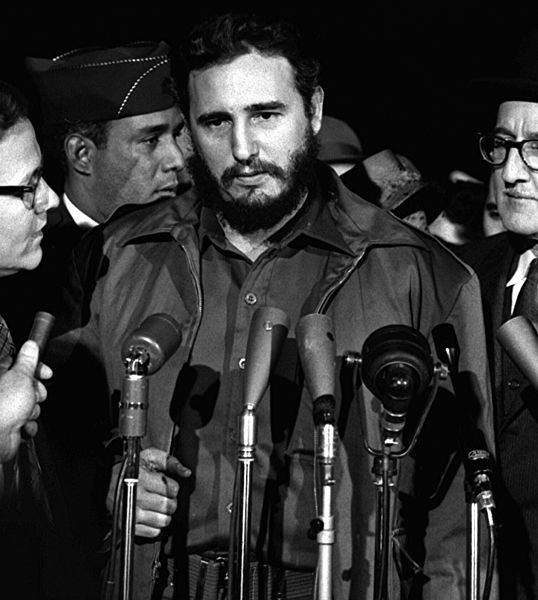
Fidel Castro, Hero
Over 100 US congressmen and women have called for an end to the criminal Cuba embargo. Ever wonder what it was like in Cuba before Castro got rid of the vultures who now live in Miami? Lets see:
In 1934 Fulgencio Batista took over the Cuban government in what became known as "The Revolt of the Sergeants." For the next twenty-five years he ruled Cuba with an iron fist, and the full blessing and endorsement of the United States government, who feared a social and economic revolution and saw him as a stabilizing force with respect for American interests.

Batista established lasting relationships with organized crime, and under his guardianship Havana became known as "the Latin Las Vegas." Meyer Lansky and other prominent gangsters were heavily invested in Havana, and politicians from Batista on down took their cut.

Through Lansky, the mafia knew they had a friend in Cuba. A summit at Havana's Hotel Nacional, with mobsters such as Frank Costello, Vito Genovese, Santo Trafficante Jr., Moe Dalitz and others, confirmed Luciano's authority over the U.S. mob, and coincided with Frank Sinatra's 1946 singing debut in Havana. It was here that Lansky gave permission to kill Bugsy Siegel.

Many of Batista's enemies faced the same fate as the ambitious Siegel. Nobody seemed to mention the many brutal human rights abuses that were a regular feature of Batista's private police force. Nobody, that is, except the many in Cuba who opposed the U.S.-friendly dictator.
and...
At first the strong man made and broke Presidents: seven of them in seven years, including Grau San Martin, whom he propped up for a few months (September 1933-January 1934). He fattened the Army from 8,000 to 20,000 men, gave it one-fourth of Cuba's budget. He put down political unrest with a hard sergeant's hand.

In the late '30s a change crept in. The dictator spoke of good dictatorship, "disciplined" democracy, constitutionality, economic reform. The cynical and the critical said that he talked big, did little to uplift Cuba's sugar-sick economy, uproot its age-old graft. But Batista began to curry civilian support. He encouraged opposition, pardoned political prisoners, even legalized the Communist Party. He cultivated culture. He took up smart squash-tennis (though he preferred cock-fighting), got a tailor, elbowed a way into Havana society, polished his pronunciation. He began to think of legitimizing his power. In 1940 he ran for the Presidency against his old revolutionary comrade, Grau San Martin. Batista won by a neat majority, which his opponents said was stacked by the Army.

Last year he told the politicians that they had better organize for the 1944 elections. They did not believe him until the President threatened to turn his job over to Senator Carlos Saladrigas if a new chief executive were not constitutionally elected. Then they tumbled into the arena.

New Man. The campaign was loud and ebullient, in the Cuban manner. Everyone admitted that cold, efficient Lawyer Carlos Saladrigas had no political appeal, but no one saw how he could lose. Gentle, starry-eyed Professor (of Anatomy) Grau San Martin supplied all the color, roused the mass enthusiasm.

In a soiled and wilted Panama suit, Dr. Grau stumped the countryside. The people remembered how, in his brief former Presidency during the great depression, he had tried to up wages, make more jobs. His earnest voice, his fervid sermons against corruption, his glowing talk of more schools and better roads, of Pan American solidarity and Cuba for the Cubans, sparked an emotional tinder. Peasant women knelt before him, held up their babies for his touch. Many believed the myth that "honest Grau" would end taxes, rent, electric and water bills.

When he cast his vote, Grau San Martin was sure that he would win if the poll was honest. He was as surprised as anyone over the result: the fairest, most orderly, least bloody (one death) election in Cuba's turbulent politics.

What Now? At 43, Cuba's strong man suddenly had new prestige. Fulgencio Batista was hardly ripe for retirement. He talked of a long trip among Cuba's neighbor countries; perhaps the ex-cane-chopper dreamed of becoming a voice in all Latin America. He was a man to watch. He was sure to keep one eye on the home island, to counter anything smacking of unpractical government. From his balcony last week he told his pueblo that if they ever needed him, he would answer their cries. Dr. Grau, preparing to move into the Presidential Palace next October, undoubtedly heard and pondered the outgoing dictator's promise.

12-Jun-1944. Time Magaine.
Lets not forget that most Cubans lived as peasants, little more than slaves, with no hope for themselves or their future. Castro changed all that, and very much for the better.

Praise for Fidel Castro from NYC Congressman Serrano:
Today’s news that Fidel Castro has retired from leading his nation proves yet again that this important figure defies the attempts of his critics to paint him simply as a power-hungry authoritarian. Instead, it proves that Castro sees clearly the long-term interests of the Cuban people and recognizes that they are best served by a carefully planned transition. Few leaders, having been on the front lines of history so long, would be able to voluntarily step aside in favor of a new, younger generation. In taking this action, Castro is ensuring that the changes he brought about will live on and grow.

I would like to congratulate both Fidel Castro and the Cuban people for this smooth transition of power. It is much to their credit that the much-predicted turmoil following Castro’s exit from direct control of the state did not happen. It proves that there is a broad base of support for the Cuban system on the island. It also proves that despite constant criticisms, Castro’s revolution was not merely a series of military events in Cuba in the late 1950s and early 1960s, but instead a process that continues to evolve in Cuba today.

As always, I want to take the opportunity to call on the Bush administration to change its backward and counterproductive policy of blockading and isolating the Cuban people. In a moment like this, it is wise to remember that the stated goal of the Bush administration and anti-Castro hardliners has been to push Fidel Castro from power. At times it seemed as though it was a personal grudge against Castro, remade into foreign policy. But now that he has voluntarily stepped aside and relinquished power, I wonder what twisted new rationale they will create to continue their failed policies. It is long past time to end the charade and begin dialogue and engagement with Cuba.

Our two peoples are so much alike, with so many shared linkages, it is particularly sad to see us continue to dwell on false and invented divisions. I deeply hope that the new leadership in Cuba can find a new opportunity for dialogue when a new administration comes to power in the United States in January 2009. It is time to recognize that Castro was a great leader for his people — and move toward engagement with his successor. It is time to put the past struggles behind us and move forward together.
19-Feb-2008. New York Times.

Sunday, February 17, 2008

McCain? The Arizona Hawk

Is John McCain different? Will he bring a new agenda to Washington? To be sure, he is in the pocket of a slightly different group of capitalists than the Bushs. He does not pander as much to the religious right as some other Republican candidates.

However, he is a hard-core right wing war hawk and will do everything in his power to undermine and subvert the left both domestically and abroad. He has already done so, in fact, and as president he will accelerate his agenda using the full power of the state, including espionage, war and outright terrorism (in the form of assassinations, etc).

McCain's agenda is very close to being fascist insofar as his aim is to liquidate opposing world views by force with no heed paid to a democratic process nor how many people are hurt.

Hopefully he will not be elected as President of the United States. However if he is we can only expect the worst and anticipate increased world instability as a result of his reckless and hawkish policies.
Now that John McCain has presumably wrapped up the Republican nomination, it's natural to wonder what kind of foreign policy he might pursue towards the rest of the world if he were elected President. For example, how would the "maverick" McCain deal with Latin America?

In recent years, the region has taken a decidedly leftist turn; new leaders such as Hugo Chávez of Venezuela, Evo Morales of Bolivia, and Daniel Ortega of Nicaragua have openly challenged U.S. diplomatic and political influence. McCain's record suggests that he would pursue a very hawkish and antagonistic policy in the hemisphere. It's even possible that the Arizona Republican, who has suggested that the United States might be in Iraq for hundreds of years and might "bomb, bomb, bomb, Iran," could ratchet up military tensions in Latin America and escalate conflict with countries like Venezuela.

The International Republican Institute (IRI)

McCain has chaired the International Republican Institute (IRI) since 1993. Ostensibly a non-partisan, democracy-building outfit, in reality the IRI serves as an instrument to advance and promote the most far right Republican foreign policy agenda. More a cloak-and-dagger operation than a conventional research group, IRI has aligned itself with some of the most antidemocratic factions in the Third World.

On the surface at least, IRI seems to have a rather innocuous agenda including party building, media training, the organization of leadership trainings, dissemination of newsletters, and strengthening of civil society. In reality, however, the IRI is more concerned with crushing incipient left movements in Latin America.

One of the least known Washington institutions, IRI receives taxpayer money via the National Endowment for Democracy and the U.S. Agency for International Development (U.S. A.I.D.). The organization is active in around sixty countries and has a budget of $74 million. On the board of IRI, McCain has been joined by a who's who of Republican bigwigs such as Senator Chuck Hagel of Nebraska, former National Security Adviser Brent Scowcroft, and former U.S. Ambassador to the United Nations Jeane Kirkpatrick.

Kozloff, Nicholas. 14-February-2008. CounterPunch.

Real Income for Most Venezuelans Increases 328%

The capitalist press continues to distort the socialist revolution in Venezuela and raise crisis after crisis. Between 2004-2006 the real income (inflation adjusted) of the poorest 58% of Venezuelans increased by 130%, in other words, their incomes more than doubled. At the same time, state run supermarkets (Mercal's) offer basic foodstuffs for an average 39% discount over retail. This means the purchasing power of the average Venezuelan has increased by 328%. An example:
  • In 2004 you made $10 per week and milk cost $2 a gallon. You can buy up to 5 gallons of milk per week.
  • In 2006 you made $20 per week and milk at the Mercal cost $1.22 a gallon. You can now buy 16.4 gallons of milk per week.
The capitalist market has failed to respond to the increased demand effectively. In fact, there are widespread reports of distributors and speculators actually hoarding foodstuffs in an attempt to raise prices further. This has even been reported on the supply side, for instance, whereby multinational corporations are withholding or under-producing inputs into the local farming economy impacting the ability for farmers to produce the needed foodstuffs.
Problems like these are common in young socialist economies. In Cuba, shortly after the revolution, the government established a fixed low price for milk by subsidizing the stores that sold it. Overnight, milk shortages occurred. Parents who previously couldn't afford milk for their children now found that they could. This option didn't exist under the Batista regime. The U.S. press used this "milk shortage" to show that socialism had failed, when it actually had succeeded, especially for parents who could now afford to buy milk.

Irelan, Patrick. Feburary 15, 2008. CounterPunch.
Corruption is common especially at times of great economic change. This has been shown in the housing bubble in the first world economies. In Venezuela it is no different, a massive and rapid increase in purchasing power has spiked demand and there are those who look only to their personal profit.

The situation also demonstrates how integrated economic systems are and how both internal and external pressures can easily destabilize prices and supplies in the short term. But what is the solution?

First we must identify the problem. Capitalists would identify the problem as a classic case of supply and demand. Their cynical view leads them to the conclusion that the demand is too high, therefore prices should be allowed to rise, thereby curtailing demand and achieving equilibrium. This may be an appropriate "solution" for the iPod market, although I am not convinced even in this case.

But herein lies the problem with reducing all things to commodities. Food is essential for human life, therefore market driven pricing is inappropriate. A society must apply a minimum amount of resources to producing enough food for their own population. This basic subsistence level should be guaranteed for all people and the necessary resources, human and capital, should be applied to ensuring the proper level of production for the given population.

The latifundia model common in Latin America and in other countries with export oriented cash crops is completely the opposite from this. In this model, a nations entire agricultural sector is geared towards production of some export crop, be it tobacco, beef or sugar, and the basic foodstuffs are imported from abroad (usually the United States or EU). All agriculture is commoditized, and nations have no way to ensure food security for their populations.

Food security will likely be the key battleground in the coming century. As oil reserves continue to decline and bio-fuel continues its stellar rise, the ability for the US and the EU to export massive amounts of grain at competitive prices will rapidly decline. At the same time, the wholesale influx of the world peasant class (over 3 billion people) into shantytowns (in the 3rd world) or new factory cities (China, India) and out of self-sufficient food production will continue to decrease variegated national food production. This process has been accelerated by the expropriation of peasant plots by large land holders (primarily ranchers), corporations, and in the case of China, the government.

The upshot will be that nations will have no choice but to focus on food security. The commodity model will fail. The market will fail. People will starve. Production, processing and distribution must be in the control of a local democratic people's government and guaranteed for all citizens. Production, processing and distribution must be organized around rational, scientific principles, and monitored in a humane and moral manner. It is good to see that the government of Venezuela understands this and is taking measures now to ensure a future of food security for all its people.

Monday, February 11, 2008

Hugo Chavez Threatens US Oil Supply

In response to Exxon's aggressive tactics of "judicial terrorism", President Chavez of Venezuela has threatened an oil embargo against the United States.

Meanwhile, the US and international media circus is using this scenario in their continued "Howard Dean Howl" campaign against Chavez.

Most recently the (CIA) coordinated ¿Por qué no te callas? smear campaign gained a lot of traction in the Spanish speaking world. Ironically, Chavez was correct in saying that Spain's King Juan Carlos is a fascist collaborator- it is historical fact ("The king, who spent much of his early life in exile and was groomed by Gen Francisco Franco, the fascist dictator [of Spain], as his successor" - and he's still at it!). What kind of world do we live in where fascists are made out to be heroes whereas socialists and idealists are made out to be fools? Who actually won WWII?

The goal of these campaigns is to discredit and undermine Chavez, make him out to be a fool, and thereby undermine the entire socialist project in Venezuela.
Venezuela's Energy Minister, Rafael Ramirez, characterised a series of court orders obtained by Exxon Mobil Corp. in Britain, the Netherlands, and the Dutch Antilles, freezing up to $12 billion in assets of Venezuelan state oil firm PDVSA, as "judicial terrorism," in a statement today.

The injunctions were solicited by Exxon in anticipation of an arbitration ruling by the International Centre for Settlement of Investment Disputes over a compensation claim. As part of a drive to recover the nation's oil sovereignty the Venezuelan government nationalized Exxon's 41.7 percent stake in the Cerro Negro project in May last year with an offer for compensation. However, Exxon not satisfied, demanded arbitration. Although the U.S. oil giant has not specified how much it wants in compensation it said its investment in the project was valued at $750 million at the time the assets were expropriated.
Note that the judicial process has threatened to freeze between 12-43 billion in PDVSA assets, whereas Venezuela has been in ongoing negotiations with Exxon regarding only $750 million in compensation.

continued...
"This is pure judicial terrorism," Ramirez told reporters in Caracas. "If they think that with this they will get us to backtrack on our nationalization policies, well, gentleman from Exxon Mobil, you are dead wrong again."

Exxon presented the documents to the Federal Court in Manhattan on Thursday and is petitioning the court to ratify the injunctions in a hearing scheduled for February 13. However, Ramirez said the injunctions are temporary as all the court orders are subject to appeal.

"We don't have any decision in any court that is definitive. We have a temporary measure in a court in New York and we have the right to respond, that is to say a transitory measure and we are sure that we are going to defeat this measure," he assured.

The London High Court order was granted on Jan. 24 without any prior notice to the Venezuelan oil company. The next hearing on the matter is scheduled for Feb. 22.

Until then, PDVSA is barred from removing any assets in England or Wales up to a value of $12 billion. While attachment orders from courts in the Netherlands and Netherlands Antilles also grant injunctions up to $12 billion against PDVSA in these jurisdictions, Margaret Ross, an Exxon spokesperson in Houston, said the sum total that could be frozen worldwide was $12 billion.
It is interesting the way that Exxon is promoting this court ruling. It seems to be part of an integrated media campaign designed less to cripple PDVSA or recoup the $750 million, and more to continue the cycle of discrediting Chavez while attempting to create a crisis on the ground in Venezuela. A recent CIA report characterized Venezuela as a regional threat to US interests. One of the challenges they highlighted was that the ruling classes of Venezuela were being co-opted by the socialist reforms because they were in fact very good for the economy and creating profits. These types of smear tactics are designed to get those people to feel uncomfortable with Chavez and to join the opposition.

continued...
Ramirez said that PDVSA's assets in the jurisdictions covered by those countries are valued at significantly less than $12 billion and emphasised that the decision would not affect the company's cash flow and operational capacity. PDVSA's global assets are valued at $107 billion, he added.

However, the injunction could affect PDVSA's European refining assets, particularly a 50% share in German joint venture Ruhr Oel, which according to filings PDVSA made with the U.S. Securities and Exchange Commission in 2006, were held through a Netherlands Company PDV Europa BV.

In the context of soaring energy prices, the move by Exxon is a particularly aggressive challenge to governments around the world who are trying to recuperate soveriegnty over their natural resources.
"To me it sounds like a very aggressive tactic," said Stephen Zamora, professor of international law at the University of Houston Law Center.

"I can't really say that I'm aware this has been used in other investment disputes. They may be trying to get the government to settle."
What? A new tool being used by international capital to undermine socialist revolution? They are changing the rules? They are making a small country that is trying to travel a different path play by different rules than they play by? Golly that just ain't fair!

continued...
Patrick Esteruelas, of the Eurasia Group in New York commented, "Although Exxon is within their rights to persue a temporary embargo of PDVSA assets they will probably have to prove that PDVSA has no intention of compensating them."

"However, PDVSA has been very careful to insist that they will still negotiate with Exxon to achieve an acceptable compromise," he added.

Ramirez said the media publicity was a result of Exxon trying to "scratch a figure into the negotiating table" to affect compensation talks and said the world's largest oil company's compensation demands were "ridiculous."

He also accused the US company of using the legal case to destabilize Venezuela, by creating panic over its finances, as the country's dollar denominated bonds experienced their sharpest drop in six months on fears the government could face a protracted legal battle with the oil giant.

PDVSA, which supplies about 10% of the U.S's oil, is a crucial source of funds for the Venezuelan government's social programs that provide free education and healthcare to the poor. In 2006, the company spent $13.3 billion on such programs, up from $6.9 billion in 2005 and more than double the $5.8 billion it invested in new domestic gas and oil projects.
Fox News hates this. The neo-fascists (and neo-liberals for that matter) continually claim that PDVSA is wrong to use its profits to rebuild Venezuela.

continued...
Ramirez said that the interests of the Venezuelan nation were more important than any corporation and assured that Venezuela would not back down from its policy of full oil sovereignty. We are "being attacked by a transnational corporation," but, "we are not going to back down, we are going to beat them in this battle," he said.

Caracas, February 8, 2008 (venezuelanalysis.com)
See also:
http://www.bloomberg.com/apps/news?pid=20601086&sid=aCQq4aSyDsI4&refer=latin_america

Wednesday, February 06, 2008

Union Membership Rises in 2007!

The Bureau of Labor Statistics reported the largest rise in the number of U.S. workers belonging to labor unions in the last quarter-century. In 2007 the rolls increased by 311,000 for a total of 15.7 million workers, despite a decline in manufacturing jobs, particularly in auto.

The overall percentage of organized workers rose to 12.1 percent of the workforce, including 7.5 percent of private-sector workers and 35.9 percent of public-sector workers. Membership grew most in construction and health services, with a higher rate of 14.7 percent in Western states compared to 13.8 percent in Midwestern states.

Labor leaders hailed the turnaround. Stewart Acuff, AFL-CIO organizing director, cited organizing drives of 40,000 child care workers in Michigan and New York. (New York Times, Jan. 26)

IWW On The Picket Line. 6-Feb-08.

Western Media Propaganda Arm of Empire

The evidence should be clear more now than ever. News organizations are tools of specific segments of ruling class political opinion. The only reason to "read" them is to understand what agendas are being advanced and foisted upon the general public.

It is here that the truest form of democracy we have access to in late capitalist society exists - the "democracy" of the commodity purchase, in this case the purchase of propaganda. The news we buy and read tilts the economic landscape this way and that. So it seems that all we have left is to "vote with our dollars."

That, or reject the entire corrupt edifice wholesale.

From an excellent article by Toni Solo:
The main reason now to read most Western Bloc corporate media is to discover what lies they are spreading on behalf of their countries’ governments and corporations. In the case of Venezuela, Carlin’s piece indicates that one can expect a ratcheting up of the propaganda war against Venezuela over the next year or so.

[...]

But perhaps the most relevant point about Carlin’s particular brand of misreporting is that it confirms the intimate links between European mainstream media and European country governments and security services. Carlin’s piece is very much in the style of an older UK anti-journalist called Chapman Pincher. Pincher used to make a comfortable career writing screeds just like Carlin’s, based on unattributable sources, smear and guilt by association, regurgitating whatever the official propaganda line of the day may happen to have been.

Solo, Toni. The Observer Exclusive: Hugo Chavez is President of Venezuela. Venezuela Analysis. 03-Feb-2008.
From the Project for Excellence in Journalism:
Journalists are unhappy with the way things are going in their profession these days. Many give poor grades to the coverage offered by the types of media that serve most Americans: daily newspapers, local TV, network TV news and cable news outlets. In fact, despite recent scandals at the New York Times and USA Today, only national newspapers ­ and the websites of national news organizations ­ receive good performance grades from the journalistic ranks.

Roughly half of journalists at national media outlets (51%), and about as many from local media (46%), believe that journalism is going in the wrong direction, as significant majorities of journalists have come to believe that increased bottom line pressure is "seriously hurting" the quality of news coverage. This is the view of 66% of national news people and 57% of the local journalists questioned in this survey.

Journalists at national news organizations generally take a dimmer view of state of the profession than do local journalists. But both groups express considerably more concern over the deleterious impact of bottom-line pressures than they did in polls taken by the Center in 1995 and 1999. Further, both print and broadcast journalists voice high levels of concern about this problem, as do majorities working at nearly all levels of news organizations.

The notable dissent from this opinion comes from those at the top of national news organizations. Most executives at national news organizations (57%) feel increased business pressures are "mostly just changing the way news organizations do things" rather than seriously undermining quality.

Bottom-Line Pressures Now Hurting Coverage, Say Journalists. The Pew Research Center. 23-May-2004.
Of course the executives don't feel quality has gone down. Quite the contrary, from their perspective, quality has gone UP. Because the product they wish to generate has nothing to do with a free press, but with satisfying their class interest in order to secure their continued advancement upward in bourgeois society. Nevermind those pesky journalistic ideals. From a capitalist perspective, these are nothing more than product defects. The removal of which need not even be (consciously) poltically motivated.

Wednesday, January 09, 2008

Kucinich, Ron Paul Censored by US Media

Is this what neo-liberalism means by "democracy?" Or perhaps the ruins of Iraq are democracy? It is ironic (in so many bloody ways) that the CIA has cited Venezuela for "anti-democratic" tendencies on their "World Factbook" - Big Brother is watching, are you? I suppose the good news is that these tactics build consciousness in the popular classes who support "fringe" candidates like Paul and Kucinich. They see that despite their democratic, grass-roots organizing efforts, there is no level playing field and the upper echelons of the ruling classes are playing for all the marbles, and wining...
First it was News Corps FOX Republican forum in New Hampshire in which Ron Paul was snubbed, now it's Dennis Kucinich who was censored by Disneys ABC. Do I have to say much more, well sure I will. FOX claimed the omission of Paul was due to lack of his support even though Paul took 10% in Iowa , . The co-sponsor of the NH Democratic debate Facebook recently polled Kucinich at over 5%, the criteria to appear on the debate, the command from Disney came down that he was not to appear anyway. What are they scared of? These men chose to be on the ballot, met the so-called criteria and the media should allow them to express and debate their opinions with their fellow candidates on the nationwide scale. What is happening? Where is our Freedom of Information? Even the Republican Party of New Hampshire cried foul, after trying their hardest to get Paul and Hunter onto the Debate, the GOP party of NH withdrew as a partner in the Forum and their chairman stated:

"The first-in-the-nation New Hampshire primary serves a national purpose by giving all candidates an equal opportunity on a level playing field. Only in New Hampshire do lesser known, lesser funded underdogs have a fighting chance to establish themselves as national figures,” and "(NH GOP Party)..believes Congressmen Ron Paul and Duncan Hunter should be included in the FOX forum on Sunday evening. Our mutual efforts to resolve this difference have failed."

Kucinich joins Paul - Censored by Big Media from national debates. Union Review. 08-Jan-2008.

Sunday, January 06, 2008

Imperial Decline?

I've been writing about economic decline and the credit burst for several years now. The majority of the ruling classes have finally moved the majority of their profits into save harbors like bonds and gold (what about you?) - so the signal was given to officially announce the specter of recession. Another world is possible and in fact being built in Venezuela. Unfortunately, many will suffer in the coming downturn.
"from 1920 to 1960, Venezuela was the leading world exporter of oil and here, through our Caribbean sea passed thousands of boats loaded with oil: but they left nothing to benefit the peoples of the Caribbean, the sister peoples of Latin America. Today revolutionary Venezuela places this wealth, above all, at the disposal of our sister peoples of the Caribbean and of Latin America: not for the North American empire." Hugo Chavez Frias, from closing words at Fourth Petrocaribe Summit.

Returning to Europe after some time away is like visiting an unloved relative falling into dementia. It may be unwelcome, but one sheds no tears. The persistent optimism of Western Bloc political and financial leaders is bizarre. For example Brian Cowen, Ireland's Finance Minister presented a budget recently based on projected inflation through 2008 of a little over 2% and growth in gross domestic product at 3%. Subsequently, Ireland's Economic and Social Research Institute's latest quarterly economic commentary reckoned growth at nearer 2% and inflation at over 3%.

But as this decade's credit boom slumps into bust, service-skewed economies like those in the US, Britain and Ireland are likely to be hit much harder than these forecasts suppose. Most people, businesses and households, more or less heavily in debt, will cut back hard on non-essential spending. That will probably create a vicious downward spiral as increasing numbers of people are made unemployed and overall consumer demand drops correspondingly. At the same time, creeping inflation will make everything dearer for people to buy. The full effects of all these processes are unlikely to work themselves out until late 2009 at the earliest.

Rich-country economists read their tarot card statistics blinkered by arrays of crystal-ball maybe-maybe-not data. But for millions of households in Asia, Africa and Latin America facing significant drops in family remittances as rich country economies go belly-up through 2008, real life stares them brutally in the face. For low-income families and communities in Africa, Asia or Latin America the effects of the coming recession will be far more devastating than for people in Europe and the US. Countries bullied into US-style trade-in-your-sovereignty pacts or EU-style Europeans-only-let's Party Agreements with the globalization devil will find their souls quickly ripped apart as the funny-money credit boom collapses into dwarf-star stagflation or a recessionary black hole.

[Full article linked below]

Solo, Toni. Varieties of Imperial Decline: Rearguard Success, Strategic Defeat. ZNet. 03-Jan-2008.